RESIDENTIAL / Privacy & Decorative
Ground-Floor Privacy Window Film for Street-Facing Glass
Ground-Floor Privacy Window Film for Street-Facing Glass: daytime screening, frosted privacy and a cleaner finish for exposed windows.
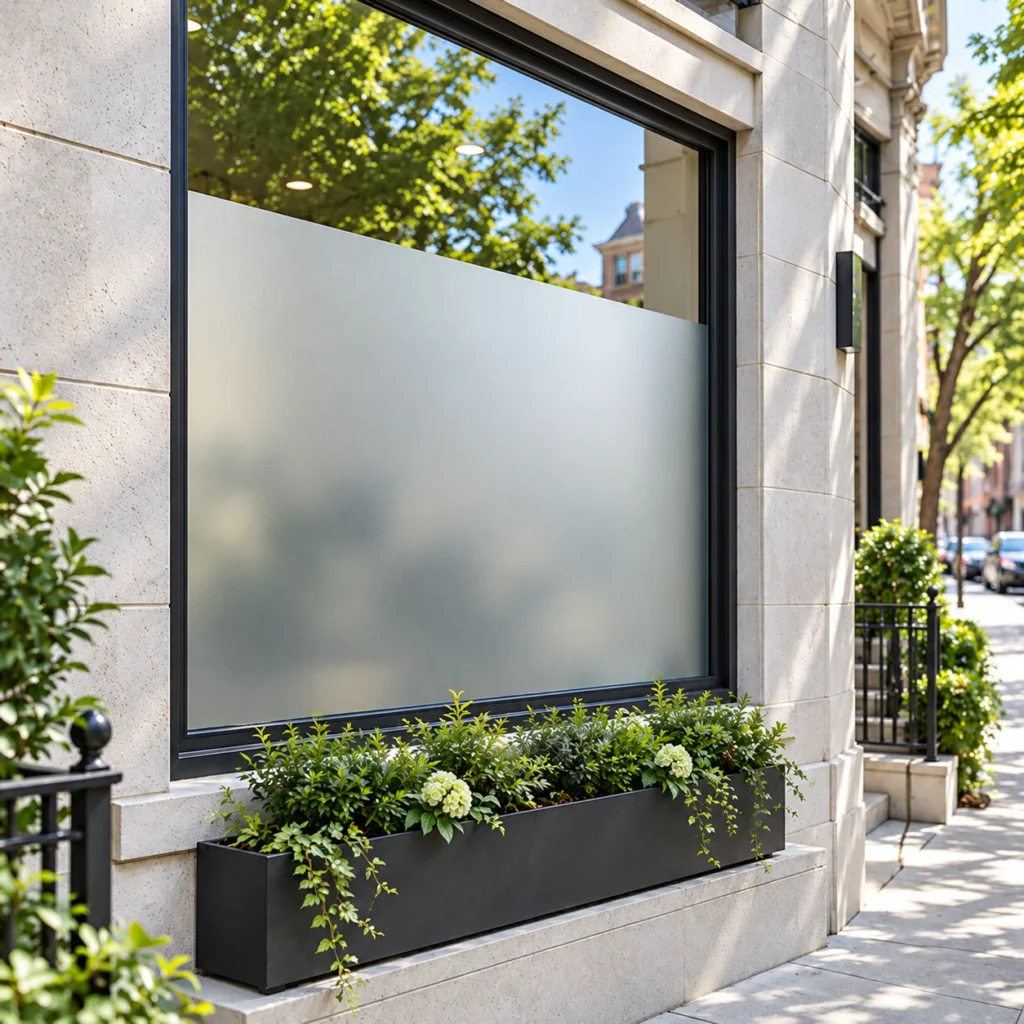
Ground-floor and street-facing windows are useful for bringing daylight into a room, but they can also make homes, apartments, offices, clinics, storefronts, and other commercial spaces feel more exposed than they should. When pedestrians, neighbors, customers, or nearby traffic can see directly through the glass, people often end up keeping blinds or curtains closed for most of the day. That may improve privacy, but it also blocks natural light, restricts the outside view, and can make the room feel smaller or less welcoming.
Privacy window film offers a more practical way to control visibility without automatically covering the entire window with a heavy treatment. Depending on the film selected, the glass can provide daytime privacy, a frosted appearance, a darker privacy finish, or complete visual blocking. ProLayers offers different architectural film options so the glass can be matched to the actual privacy requirement instead of treating every room in the same way.
The right solution depends on where the window is located, how close people can get to the glass, whether the outside view needs to remain visible, and whether privacy is required only during daylight hours or throughout the day and night.
Why Ground-Floor Windows Need More Privacy Control
Windows on upper floors naturally have more separation from sidewalks, neighboring properties, entrances, and parking areas. Ground-floor glass does not have that advantage. A living room facing the street, an apartment bedroom beside a walkway, or an office positioned directly behind storefront glass may sit almost directly in another person’s line of sight.
This does not always mean the window needs to become completely opaque. In many situations, the goal is simply to reduce direct visibility while keeping the room bright and usable. In other areas, such as bathrooms, entry sidelights, consultation rooms, or private offices, stronger obscurity may be more appropriate.
A well-selected film allows the privacy level to match how the room is actually used.
Key Situations Where Privacy Window Film Makes Sense
Privacy film can be particularly useful when ordinary window coverings are affecting daylight, appearance, or usability. Common situations include:
- Ground-floor living rooms facing sidewalks, streets, or shared driveways.
- Bedrooms where neighboring properties have a direct view into the room.
- Apartment windows located beside common walkways or shared outdoor areas.
- Bathroom windows and entry sidelights where consistent visual obscurity is required.
- Home offices where the window faces pedestrians or nearby buildings.
- Storefront offices positioned behind large street-facing glass.
- Conference rooms and meeting areas surrounded by clear internal glass.
- Reception areas, clinics, consultation rooms, and customer-facing workplaces.
- Commercial spaces where privacy is needed without permanently covering the glazing.
The best treatment is not necessarily the darkest film available. Privacy should be balanced with daylight, exterior appearance, room function, and the level of visibility that the occupants actually want to retain.
A. Daytime Privacy While Keeping the Outside View
For some street-facing windows, people still want to see outside. Living rooms, kitchens, offices, and other frequently used spaces can feel uncomfortable when curtains remain closed throughout the day, especially when the window provides useful natural light.
For these applications, daytime privacy films such as ProLayers Skyline 5 / 15 and Harmony DR 7 / 17 can help reduce outside visibility while maintaining a view from the interior. These darker architectural films are useful where the aim is to create more separation from pedestrians, neighboring properties, or nearby buildings without completely obscuring the glass.
Daytime privacy, however, depends heavily on lighting conditions. When the exterior is brighter than the interior, darker or reflective glass can make it more difficult to see inside. After sunset, the lighting relationship can reverse. If interior lights are bright while the exterior is dark, privacy can be reduced. Rooms requiring dependable nighttime privacy should therefore use curtains, shades, Frost, White Out, Black Out, or another appropriate obscuring solution.
B. Frosted Privacy for Bright Rooms
Some rooms need consistent privacy but do not need the window to become dark. This is where frosted film can be particularly effective.
ProLayers Frost creates an etched-glass appearance while allowing 75% light. Instead of relying primarily on reflectivity, it obscures the direct view through the glass. That makes it suitable for windows and partitions where people want daylight but do not want clear visibility from one side to the other.
Frost can work well on bathroom windows, entrance glass, sidelights, internal office partitions, consultation rooms, conference rooms, and lower sections of street-facing windows. It can also be applied selectively. For example, only the lower half or eye-level section of a window may need frosting while the upper glass remains clear.
This approach can provide privacy without making the room feel unnecessarily enclosed.
C. Opaque and Blackout Privacy for Stronger Separation
Not every window needs transparency. Some areas require the glass to function more like a visual barrier than a traditional window.
ProLayers White Out creates an opaque white appearance, making it suitable for areas where visual separation is more important than an outside view. ProLayers Black Out provides 0% light and is designed for applications where blocking visible light is required.
These options can be useful in spaces such as:
- Back-of-house commercial areas where visibility through the glass is unnecessary.
- Selected office rooms requiring stronger visual separation.
- Media rooms where outside light interferes with screens or presentations.
- Garage glass or utility areas where an outside view is not needed.
- Interior glazing that needs to be converted into a fully obscured surface.
- Areas where privacy must not depend on changing daylight conditions.
The choice between Frost, White Out, and Black Out should be based on how much light and visibility the space still needs.
Our products
Six film families, one for every kind of glass
For frosted, opaque and blackout privacy, start with Decorative and Privacy. For daytime privacy with a view, see Architectural Solar Control. Every family has its own page with the full range.
- Clarity IR Max
- Nano Ceramic
- Climate IQ 50
- Skyline
- Harmony DR
- Soft Tone
- Eco Silver 20
- X-Clear 70
- X-Eco Silver 15
- X-Hybrid DR 15
- Safety 4 Clear
- Security 8 Clear
- Security 8 Silver
- Security 14 Clear
- X-Safety 7
- AG 6 Clear
- Frost
- White Out
- Black Out
- Poly Layers
- V6 Comfort BLK
- V10 Ceramic IR BLK
- V16 Ceramic IR MAX
- V6 Core
- V10 Reactive
- V16 Velocity
Decorative Film Window Solutions for Better-Looking Privacy
Privacy improvements should not make the glass look temporary or unfinished. A properly selected decorative film window treatment can add privacy while helping the glass maintain a cleaner architectural appearance.
Decorative films are particularly useful where large areas of clear glass feel too open. Instead of covering the entire area with blinds, a frosted or obscuring treatment can be applied in a controlled way. This can include full-pane frosting, partial-height frosting, horizontal privacy bands, or selected panels.
In residential settings, this approach works particularly well on front doors, sidelights, bathroom windows, and ground-floor rooms. In commercial settings, it can help divide spaces without rebuilding walls or replacing existing glazing.
Commercial Decorative Window Film for Offices and Public Spaces
Clear glass is widely used in offices, clinics, meeting rooms, reception areas, retail environments, and other commercial interiors because it keeps spaces open and allows light to move between rooms. The downside is that fully transparent glass does not always provide enough privacy for meetings, consultations, staff areas, or customer conversations.
Commercial decorative window film allows businesses to keep the benefits of glass while creating stronger visual separation where required. Frosted sections can reduce direct visibility into conference rooms. Privacy bands can be placed at eye level on glass partitions. Fully obscured films can be used where stronger separation is necessary.
For businesses, the result is often more flexible than permanently covering the glass because the existing glazing remains in place and the treatment can be selected around the room’s function.
Privacy Window Film for General Contractors and Commercial Projects
For renovation, tenant-improvement, glazing, office fit-out, and property upgrade projects, privacy window film for general contractors can provide a practical solution when privacy needs vary throughout the building.
One project may require several different treatments. Exterior-facing offices may need daytime privacy. Conference rooms may need frosted internal glass. Utility areas may require full opacity. Street-level rooms may need additional screening from pedestrians.
Contractors and project teams should review:
- The existing glass type and glazing configuration.
- Whether the film will be installed on an interior or exterior surface.
- The amount of daylight that should remain in the space.
- Whether occupants still need to see outside.
- The level of privacy required during daytime and nighttime conditions.
- The visual appearance expected from both sides of the glazing.
- Access conditions for installation and future maintenance.
This prevents a film from being chosen only because it looks dark or reflective without considering how it will actually perform in the intended space.
Interior vs. Exterior Decorative Window Film
Most decorative and privacy treatments are applied to an accessible interior glass surface, but some projects have access restrictions or glazing configurations that require a different approach.
When a specification calls for exterior decorative window film, the glass type, exposure, film compatibility, surface condition, and intended application should all be reviewed before a product is selected. Exterior applications are exposed to different environmental conditions than interior installations, so an exterior-rated solution should be used where outside-glass application is required.
The film should always be matched to the specific glazing and project conditions rather than assuming that the same treatment is appropriate for every window.
Keep reading
More window film guides for your home
Privacy Film vs. Curtains, Blinds, and Privacy Glass
Different privacy solutions work well in different situations. The most suitable option depends on how permanent the treatment should be, how much light needs to remain, and whether the outside view is important.
| Privacy Option | Daylight | Outside View | Typical Application |
|---|---|---|---|
| Skyline 5 / 15 or Harmony DR 7 / 17 | Reduced according to shade | Maintained during suitable daytime conditions | Street-facing living rooms, offices, exterior glass |
| Frost | 75% light | Obscured | Bathrooms, sidelights, meeting rooms, lower panes |
| White Out | Strongly obscured | No clear view | Private rooms, commercial glass, selected partitions |
| Black Out | 0% light | No view | Media rooms, garages, utility or back-of-house areas |
| Curtains or blinds | Adjustable | Blocked when closed | Bedrooms, living rooms, nighttime privacy |
| Replacement privacy glass | Depends on glass | Usually obscured | Permanent glazing replacement projects |
Window film is particularly useful when the existing glass is still suitable and the main objective is to change privacy, appearance, or visibility without replacing the entire glazing unit.
Three Things to Decide Before Choosing Privacy Film
Before selecting a privacy treatment, consider these three factors:
- Decide how much visibility you want to keep. If seeing outside is important, a daytime privacy film may be more suitable than full frosting or opaque film.
- Decide whether nighttime privacy matters. Reflective daytime privacy should not be treated as continuous nighttime privacy when interior lighting becomes brighter than the exterior.
- Decide how much natural light the room needs. Bathrooms, offices, hallways, and entry areas often benefit from frosted privacy because light can remain while direct visibility is reduced.
Making these decisions first makes it easier to choose a film based on the room rather than simply selecting the darkest available option.
FAQ
Frequently asked questions
Six quick answers about privacy film for ground-floor and street-facing windows.
Still have a question? Ask usDoes Privacy Window Film Stop People From Seeing Inside?
It depends on the type of film. Frosted and opaque films obscure the view through the glass, while daytime privacy films reduce visibility under suitable lighting conditions while allowing occupants to maintain more of the outside view.
Does Reflective Privacy Film Work at Night?
Not in the same way it works during daylight. When interior lighting is brighter than the exterior, visibility through reflective or dark glass can increase from outside. Curtains, shades, frosted film, or an opaque solution should be considered when continuous nighttime privacy is required.
Can Privacy Film Be Applied Only to the Lower Half of a Window?
Yes. Partial coverage is often useful for ground-floor windows because the lower or eye-level portion may be the main area exposed to pedestrians and neighboring properties. The upper section can remain clear to preserve daylight and openness.
Is Decorative Window Film Suitable for Commercial Offices?
Yes. Commercial decorative window film can be used on conference rooms, private offices, clinics, reception areas, glass partitions, and other spaces where transparent glazing needs more visual separation.
Can Frosted Film Still Keep a Room Bright?
Yes. ProLayers Frost provides an etched appearance while allowing 75% light, making it suitable where the objective is to reduce direct visibility without heavily darkening the room.
Is Window Film Better Than Replacing the Glass?
They serve different purposes. If the existing glass is suitable and the main goal is privacy or appearance, film can modify the existing surface without replacing the glazing. Full glass replacement may be appropriate when the window itself also needs structural, glazing, or other performance changes beyond what film is intended to provide.
Contact us
Street-facing glass feels exposed? Tell us about the room.
Send us the window size, what it faces and how much privacy you need, and we will point you to the right next step.
Contact us-
Visit
12551 Steepleway Blvd SWB B101
Houston, TX 77065 - Hours Mon to Fri 9am to 5pm