RESIDENTIAL / Safety & Security at Home
Broken Glass Risk? 8 Mil Security Window Film for Homes
Broken Glass Risk? 8 Mil Security Window Film for Homes helps hold shards together around kids, pets and low-level glass.
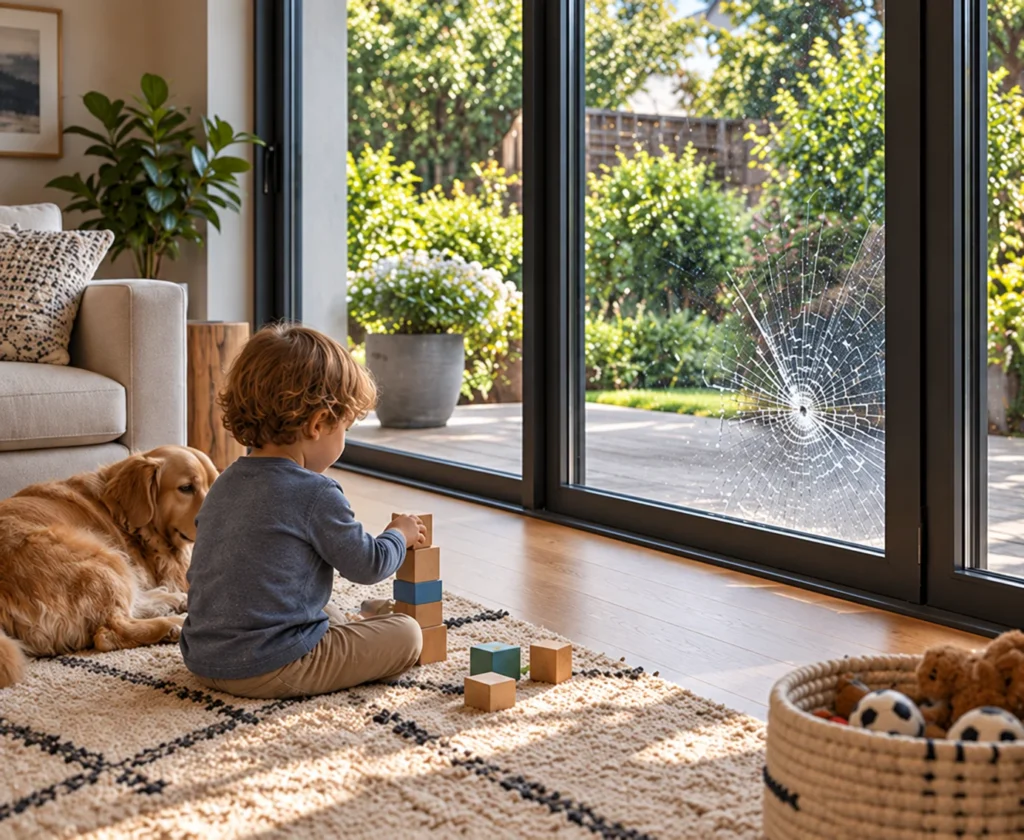
Glass doors, low windows, sidelites, and large glass panels can make a home feel bright and open. But when glass is close to the floor, it can also be in the same space where children play, pets run, and family members move every day.
A hard toy, an accidental fall, moving furniture, or another sudden impact can break the glass. The concern is not only the broken pane. Loose pieces and sharp fragments can spread into the room and create an added injury risk.
Safety and security window film is designed to help keep broken glass fragments together after impact. It does not make ordinary glass unbreakable, but it can help control how broken glass behaves and reduce the amount of loose glass entering an occupied space.
For homes with children, pets, busy entryways, or low-level glazing, that extra layer can be worth considering.
Why Low-Level Glass Deserves Extra Attention
Low-level glazing is simply glass positioned where people or pets can easily come into contact with it. You may have several areas like this in your home without thinking of them as safety concerns.
Common examples include:
- Sliding patio doors
- Full-height glass doors
- Glass close to the floor
- Door sidelites
- Large living room windows
- Glass beside stairs or hallways
- Low glass near indoor play areas
- Sunroom and conservatory glass
- Glass near pet doors or busy walkways
Children can run into glass while playing. Dogs may jump toward a door when they see someone outside. A person can slip or lose balance near a large pane.
You cannot remove every everyday accident, but you can look at how your existing glass may behave if it breaks.
What Does Safety Window Film Do When Glass Breaks?
Safety and security film is bonded to the surface of the glass. If the glass breaks, the film is designed to help hold many of the broken pieces together instead of allowing them to separate freely.
This glass-retention function is one of the main differences between a purpose-made safety film and a standard decorative or solar film.
The goal should be clear:
The film is not there to promise that glass will never break. It is there to help control broken glass when breakage happens.
This is especially important around doors and other areas that may be exposed to accidental human impact.
Is 8 Mil Security Window Film Better for Low-Level Glass?
People looking for 8 mil security window film are often trying to find a heavier safety or security option for existing glass.
Film thickness is important, but thickness should not be the only factor used to choose a product. The right solution depends on the complete glazing condition.
A proper assessment should consider:
- Existing glass type
- Glass size
- Door or window location
- Frame condition
- Main safety or security concern
- Film performance documentation
- Applicable building requirements
- Whether a frame attachment system is required
- Interior or exterior film suitability
A thicker film should not automatically be described as the right film for every door, window, or security situation.
The selected product needs to match the purpose of the project.
Our products
Six film families, one for every kind of glass
For glass retention around kids and pets, start with Safety and Security. Every family has its own page with the full range.
- Clarity IR Max
- Nano Ceramic
- Climate IQ 50
- Skyline
- Harmony DR
- Soft Tone
- Eco Silver 20
- X-Clear 70
- X-Eco Silver 15
- X-Hybrid DR 15
- Safety 4 Clear
- Security 8 Clear
- Security 8 Silver
- Security 14 Clear
- X-Safety 7
- AG 6 Clear
- Frost
- White Out
- Black Out
- Poly Layers
- V6 Comfort BLK
- V10 Ceramic IR BLK
- V16 Ceramic IR MAX
- V6 Core
- V10 Reactive
- V16 Velocity
Safety Film vs Regular Solar Film
A normal solar-control film and a safety or security film should not automatically be treated as the same product.
| Film or Glass Option | Main Purpose | Broken Glass Control | Solar Benefits |
|---|---|---|---|
| Standard solar window film | Heat, glare, or solar control | Not its main purpose unless specifically tested for it | Yes, depending on product |
| Safety/security window film | Glass retention and safety/security applications | Designed for this purpose | Depends on selected product |
| Combined solar + security film | Solar control plus glass retention | Product dependent | Yes, product dependent |
| Replacement safety glazing | New glazing system | Depends on glazing type | Depends on selected glass |
If broken-glass control is the main reason for your project, choose a film specifically designed and documented for that use.
Do not assume that any film placed on glass automatically becomes a safety film.
Solar and Security Window Film Can Serve Two Needs
Some properties need more than broken-glass protection. A room may also have strong sun, uncomfortable glare, excessive daytime heat, or UV exposure.
In these situations, combined products may be considered.
Possible solar and security window film benefits can include:
- Helping retain broken glass
- Reducing solar heat, depending on the film
- Controlling uncomfortable glare
- Reducing UV transmission, depending on product data
- Keeping the appearance of existing glass
- Adding more than one function to the same pane
However, performance is product-specific.
A film should only be selected after reviewing its actual technical data rather than assuming that every security film provides the same solar performance.
Kids and Glass Doors: Where Should You Look First?
Start with the glass your children pass every day.
A large pane in a room that nobody uses may be less exposed to accidental contact than a glass patio door beside a play area.
Check areas such as:
A. Patio and Sliding Doors
Large sliding doors are easy to approach quickly, especially when indoor and outdoor spaces connect directly.
They may also be difficult for young children to notice when the glass is very clear.
B. Entry Door Sidelites
Narrow glass panels beside entrance doors are often positioned close to people entering and leaving the property.
They can also sit at a height where children and pets are nearby.
C. Floor-Level Windows
A window that starts close to the floor may be exposed to toys, furniture, pets, or accidental human contact.
These areas should be considered based on the existing glass and how the room is actually used.
D. Playrooms and Family Rooms
Children may run, throw toys, move chairs, or play close to the glass.
The room layout matters just as much as the size of the window.
Pets Can Create Different Glass Safety Concerns
Pets do not always understand that a clear glass door is a solid surface.
Dogs may run toward patio glass when excited. Larger pets can place significant force against doors or low windows. Furniture near a window can also give cats and other pets easy access to glass.
Safety film cannot stop a pet from hitting the glass, and it cannot guarantee that an injury will not happen.
What it can do, when the correct product and system are used, is help control broken glass fragments after the pane is damaged.
That distinction is important.
Can Window Film Turn Existing Glass Into Safety Glazing?
This requires more care than a simple yes or no.
Safety glazing requirements can depend on the location, glass type, building code, product testing, and the complete glazing system.
In the United States, architectural glazing used in certain locations such as doors and sliding glass doors is covered by safety-glazing requirements. A film product should therefore not be marketed as code-compliant simply because it is called a safety film.
The relevant product documentation and project requirements need to be checked.
For older properties, this can be especially important because the existing glass may have been installed under different requirements or may not be clearly identified.
Keep reading
More window film guides for your home
Safety Film Is Not the Same as “Unbreakable Glass”
This is one of the most important things to understand before choosing security window film.
Safety and security film should not be sold as a product that prevents all glass breakage.
Glass may still crack or break under impact.
The purpose of the film is to work with the broken glass and help keep fragments together. The exact level of performance depends on the film, glass, frame, attachment method, impact type, and complete tested system.
Claims such as “break-proof,” “bulletproof,” or “impossible to enter” should not be assumed from film thickness alone.
What About Security Against Forced Entry?
Accidental glass safety and forced-entry protection are related, but they are not identical goals.
For accidental breakage, controlling loose glass may be the main concern. For a security application, the project may also need to consider how the filmed glass remains connected to the surrounding frame.
That is why security-focused projects may involve more than simply choosing a thicker film.
Important questions include:
- What threat is the project addressing?
- Is accidental impact the main concern?
- Is forced entry also a concern?
- What type of glass is currently installed?
- What condition is the frame in?
- Is a perimeter attachment system required?
- What testing supports the proposed system?
These questions become even more important in commercial, institutional, school, and public-building projects.
Security Film for Government and Commercial Glass
The same basic idea of broken-glass retention also appears in larger commercial security projects, but the design requirements can be very different.
Someone searching for glass door security film for government buildings may be dealing with entrances, vestibules, reception areas, or other exposed glazing. These projects should be evaluated around the required threat level and documented system performance.
Likewise, security window film for general contractors is normally part of a wider project scope. Contractors may need product documentation, glass compatibility information, specified attachment details, and clear coordination with the approved dealer or installer.
Residential glass safety should therefore not be presented as identical to a government or institutional security system.
The film may belong to the same product category, but the application and performance requirements can be very different.
Choosing Security Films in Schaumburg
Property owners searching for security films in Schaumburg should avoid choosing a product only by thickness, appearance, or a general security claim.
A better starting point is the glass itself.
Consider:
- Is the project residential or commercial?
- Is broken-glass safety the main concern?
- Is forced-entry resistance also required?
- Is solar control needed?
- What glass type is already installed?
- Does the project have code or specification requirements?
- Does the selected film have supporting technical documentation?
The same process is useful in Schaumburg, Illinois, and in any other location where safety or security film is being considered.
Local requirements should always be checked for the specific project.
When a Combined Solar and Security Film Makes Sense
Not every room needs separate solutions for heat, glare, UV exposure, and broken-glass control.
In some cases, a combined solar and security product can help address more than one goal.
For example, a family room with a large low-level window may receive strong afternoon sun while also being close to children or pets. A suitable combined film may provide solar-control features while also being designed for glass retention.
The important word is suitable.
Do not choose a combined film simply because its marketing includes several benefits. Compare the actual product data with the conditions of your glass.
What Should You Check Before Selecting a Film?
Before choosing a safety or security window film, make a simple list of what you need the glass to do.
Check the Existing Glass
Identify the type, size, location, and condition of the glass where possible.
Identify the Main Concern
Decide whether your priority is:
- Accidental broken glass
- Children and pets
- Forced entry
- Solar heat
- Glare
- UV exposure
- Privacy
- A combination of these needs
Review Product Documentation
Do not rely only on a product name or thickness.
Review available performance data and testing relevant to the intended application.
Consider the Entire Glazing System
Glass, film, frame, and any required attachment method work together.
For higher-security applications, the complete system matters.
Make Low-Level Glass a More Considered Part of Your Home
Glass close to children, pets, doors, and busy living areas deserves more attention than glass that is rarely approached.
You do not need exaggerated promises or a product chosen only because it sounds stronger.
You need a film that matches the glass, the location, and the reason you want protection.
ProLayers supplies safety and security window film solutions for different glazing needs through its dealer network. The right choice starts with identifying your main concern and matching it with the appropriate product documentation and glazing conditions.
FAQ
Frequently asked questions
Eight quick answers about security film for low-level glass.
Still have a question? Ask usDoes security window film stop glass from breaking?
No. Safety and security window film does not make ordinary glass unbreakable. It is designed to help retain broken glass fragments after breakage.
Is security window film useful in homes with children?
It can be worth considering for glass located in busy areas, especially doors and low-level glazing. The correct film should be chosen according to the existing glass and the intended safety goal.
Can security film help around pets?
It may help control broken glass if a pane is damaged during an impact. It does not prevent pets from hitting the glass and should not be presented as a guarantee against injury.
Is 8 mil security window film suitable for every home?
No. 8 mil security window film may suit certain applications, but thickness alone does not determine whether a film is right for a particular window or door.
Can safety film be used on patio doors?
Safety and security films can be considered for patio and sliding glass doors, subject to glass compatibility, applicable requirements, and the selected product’s documentation.
Is security film the same as tempered glass?
No. Window film and tempered glass are different materials and systems. Do not assume that applying film automatically gives existing glass the same characteristics as tempered glazing.
Can I get heat control and security from one film?
Some films combine solar-control and safety/security functions. The exact performance depends on the selected product, so its technical data should be reviewed before selection.
Does thicker film always provide better security?
Not automatically. Thickness is only one part of the system. Glass type, frame condition, attachment, testing, and the intended threat must also be considered.
Contact us
Low glass near kids or pets? Tell us about it.
Send us the glass size, where it is and who uses the space, and we will point you to the right next step.
Contact us-
Visit
12551 Steepleway Blvd SWB B101
Houston, TX 77065 - Hours Mon to Fri 9am to 5pm