COMMERCIAL / Solar & Energy Control
High HVAC Load? Commercial Architectural Window Film
High HVAC Load? Commercial Architectural Window Film reduces solar heat at the glass and helps ease cooling demand.
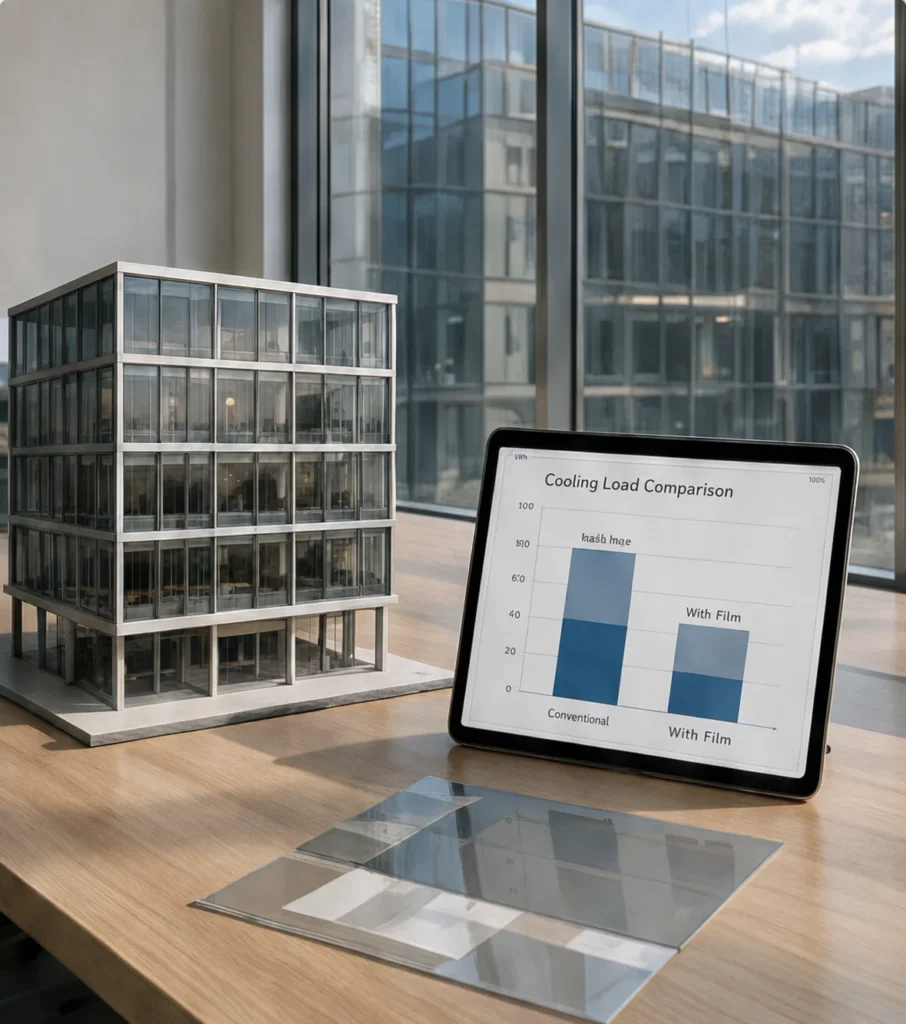
Large glass areas can make a commercial building bright and attractive, but they can also create extra work for the cooling system. Sunlight passing through office windows, storefront glass, and curtain walls adds heat to perimeter spaces. The HVAC system then has to remove that heat to maintain a comfortable indoor temperature.
Commercial architectural window film can help control this solar heat before it becomes part of the indoor cooling load. The goal is not simply to make the glass darker. The right film changes how the glazing manages solar energy, visible light, glare, and heat.
For building owners, facility managers, engineers, and property teams, this makes window film a practical building-envelope retrofit to consider before replacing existing glazing.
How Commercial Architectural Window Film Reduces HVAC Load
Solar heat entering through glass becomes part of the cooling load that the HVAC system must handle. This is especially noticeable around west-facing and south-facing glass, large curtain walls, upper floors, reception areas, conference rooms, and perimeter offices.
Solar control film changes the performance of the existing glass by reflecting or absorbing selected parts of incoming solar energy. Less solar heat entering the occupied space can mean less heat that the cooling system needs to remove.
The International Window Film Association also identifies lower solar heat gain coefficient, or SHGC, as one of the ways window film can support lower HVAC demand and building energy performance.
The basic relationship is simple:
- Solar radiation × glass area × SHGC = approximate solar heat gain through the glazing
This is not a complete energy-cost calculation. HVAC efficiency, outside temperature, building orientation, operating hours, insulation, occupancy, equipment loads, and local climate also affect the final result.
The Numbers That Actually Matter
Not every percentage on a window film data sheet tells you the same thing. Facility teams should compare the performance values that relate directly to the building goal.
| Metric | What It Means | Why It Matters for Commercial Buildings |
|---|---|---|
| SHGC | Solar Heat Gain Coefficient | Shows how much solar heat passes through the glazing system. A lower SHGC generally means less solar heat entering the building. |
| TSER | Total Solar Energy Rejected | Shows how much total solar energy the glazing and film combination rejects. |
| VLT | Visible Light Transmission | Shows how much visible light passes through the glass. It helps balance daylight, appearance, and glare control. |
| U-Factor | Rate of heat transfer through the glazing | Important when evaluating thermal performance, especially with Low-E or all-season film options. |
| Emissivity | Ability of a surface to emit radiant heat | Relevant when comparing Low-E window film and year-round thermal performance. |
| Glare Reduction | Reduction in uncomfortable visible light | Important for screens, workstations, classrooms, reception areas, and other occupied spaces. |
| IR Rejection | Reduction of infrared radiation within the stated test range | Useful performance information, but it should not be treated as the same thing as total solar energy rejection or HVAC energy savings. |
Do Not Judge Film by IR Rejection Alone
A high infrared rejection number may look impressive, but IR rejection is only one part of solar performance. It does not mean the building will reduce its HVAC energy use by the same percentage.
For cooling-load decisions, SHGC and total solar energy performance usually provide a more complete picture. VLT must also be considered when the building needs natural daylight or a specific exterior appearance.
A strong film specification looks at several numbers together instead of choosing the product with the largest percentage on the data sheet.
Why Perimeter Offices Often Feel Hotter
A thermostat may show an acceptable building temperature while employees beside the windows still feel uncomfortable.
This happens because direct solar exposure creates local heat gain near the glass. The building core may stay comfortable while perimeter offices, meeting rooms, waiting areas, or retail spaces become noticeably warmer.
Common signs include:
- Employees moving away from windows during the afternoon
- Blinds staying closed for most of the working day
- Strong temperature differences between interior and perimeter zones
- Air-conditioning running heavily during direct sun exposure
- Complaints about hot desks or conference rooms
- Screen glare near large windows
- Uneven comfort on different sides of the same building
Reducing heat at the glazing can help address the source of these perimeter conditions instead of relying only on additional mechanical cooling.
Our products
Six film families, one for every kind of glass
For sun-exposed commercial glass, start with Architectural Solar Control. Every family has its own page with the full range.
- Clarity IR Max
- Nano Ceramic
- Climate IQ 50
- Skyline
- Harmony DR
- Soft Tone
- Eco Silver 20
- X-Clear 70
- X-Eco Silver 15
- X-Hybrid DR 15
- Safety 4 Clear
- Security 8 Clear
- Security 8 Silver
- Security 14 Clear
- X-Safety 7
- AG 6 Clear
- Frost
- White Out
- Black Out
- Poly Layers
- V6 Comfort BLK
- V10 Ceramic IR BLK
- V16 Ceramic IR MAX
- V6 Core
- V10 Reactive
- V16 Velocity
Lower SHGC Can Mean Less Heat for HVAC to Remove
SHGC is one of the most important values when evaluating solar-control glazing.
A higher SHGC allows more solar energy to enter the space. A lower SHGC allows less solar heat through. When comparing two glazing systems under the same solar exposure, the system with the lower SHGC places a smaller solar heat load on the indoor space.
This is why commercial window film solutions should be selected using the existing glass type, building orientation, climate, window-to-wall ratio, and operating conditions rather than appearance alone.
Independent field testing by the U.S. General Services Administration has also shown that solar-control and Low-E film technologies can reduce cooling demand in suitable commercial applications. Results vary by building, so site-specific assessment remains important.
Where HVAC Load Reduction Can Matter Most
Window film can be especially relevant in buildings with high solar exposure or large areas of existing glass.
A. Office Buildings
Open offices and private rooms around the exterior of a building can develop afternoon hot spots. Solar-control film can help reduce incoming heat while selected VLT levels maintain useful daylight.
B. Retail Stores and Showrooms
Large storefront windows bring daylight and product visibility, but they can also expose the interior to strong solar gain. Film can help manage heat and glare without requiring complete storefront glass replacement.
C. Schools and Universities
Classrooms with direct sun exposure may experience uneven temperatures and screen glare. Managing solar gain at the window can support more balanced indoor conditions.
D. Hotels and Hospitality Buildings
Guest rooms, lobbies, restaurants, and common areas may have different solar exposure throughout the day. Window film allows specific elevations or glazing areas to be addressed according to their needs.
E. Healthcare and Clinics
Waiting rooms, offices, treatment areas, and glazed public spaces can benefit from more stable temperatures and controlled glare.
F. Commercial Curtain Walls
Buildings with large glazed facades can have significant perimeter solar loads. Film provides a way to modify existing glazing performance without automatically moving to full window replacement.
Window Film vs Glass Replacement vs Interior Blinds
Every building requires its own evaluation. The right option depends on the condition of the existing glass, performance targets, project scope, appearance, and long-term building plans.
| Factor | Window Film Retrofit | Glass Replacement | Interior Blinds or Shades |
|---|---|---|---|
| Uses existing glass | Yes | No | Yes |
| Can reduce solar gain | Yes, depending on film | Yes, depending on glazing | Limited by shade type and position |
| Can reduce glare | Yes | Depends on glass | Yes |
| Maintains outside view | Available with suitable films | Depends on glass | View may be blocked when closed |
| Changes glazing performance | Yes | Yes | Does not directly change glass performance |
| Suitable for retrofit projects | Often | Requires a larger construction scope | Yes |
| Can be selected using SHGC and VLT | Yes | Yes | Not in the same way |
Window film is particularly useful when the existing glazing is still serviceable but its solar performance no longer matches the comfort or energy needs of the building.
Why Blinds Alone May Not Solve HVAC Strain
Closing blinds can reduce visible glare, but glare and solar heat are not the same measurement.
With interior blinds, part of the solar energy may already have passed through the glass before reaching the shade. The blind can improve visual comfort while the glazing continues to contribute to heat gain.
Solar-control film addresses the glass itself. This makes it possible to consider daylight, glare, and solar heat performance as part of the building envelope rather than treating every hot space as an HVAC-only issue.
Keep reading
More commercial solar control guides
Building Orientation Changes the Result
Two identical offices in the same building may need different solutions.
West-facing glass often receives strong afternoon sun. East-facing areas may experience greater morning exposure. South-facing glazing can receive extended solar exposure depending on building location and season.
Other factors include:
- Local climate
- Glass area
- Existing glass construction
- Window-to-wall ratio
- Exterior shading
- Building height
- Occupancy schedule
- HVAC zoning
- Internal equipment loads
- Desired visible light level
- Exterior appearance requirements
For this reason, one film specification should not automatically be applied to every elevation without reviewing the glazing and project goals.
Energy Modeling Gives Better Answers Than Generic Percentages
There is no single HVAC-saving percentage that applies to every commercial building.
A small office with limited glazing does not behave like a glass office tower. A building in a hot climate will also have different heating and cooling patterns from a building in a cold climate.
A useful energy review can consider:
- Existing glass type and performance
- Total glazed area
- Window orientation
- Existing SHGC and proposed SHGC
- Building operating hours
- Local weather data
- HVAC system efficiency
- Cooling and heating loads
- Occupancy and equipment schedules
- Proposed window film performance
These inputs help facility teams evaluate expected changes rather than depending on a generic marketing claim.
The IWFA notes that building-specific film energy analysis can use modeling based on the U.S. Department of Energy's EnergyPlus platform, supporting a more realistic estimate for individual properties.
Choosing Commercial Window Film Installers
Film performance on paper is only one part of a commercial project. Glass identification, film compatibility, access, elevation, existing coatings, and project requirements should also be reviewed.
Qualified commercial window film installers or authorized dealers should be able to help confirm:
- Existing glass construction
- Interior or exterior film suitability
- Film-to-glass compatibility
- Required solar-control performance
- Desired VLT and appearance
- Glare-control requirements
- Building access conditions
- Product documentation
- Warranty requirements
- Project-specific installation planning
ProLayers supplies architectural window film through its dealer network. The appropriate film should be matched to the building rather than selected from one performance number alone.
Reduce Heat at the Glass, Not Only at the Thermostat
An HVAC system can only respond to the heat that enters a building. When large windows continually add solar heat, increasing cooling is not always the only option.
Commercial architectural window film can improve the performance of existing glazing by controlling solar gain, glare, and visible light. For offices, schools, hotels, healthcare facilities, retail properties, government buildings, and other commercial spaces, it can be considered as part of a wider building-performance strategy.
The right decision starts with the glass, the building orientation, and measurable performance data, not an unsupported energy-saving percentage.
FAQ
Frequently asked questions
Quick answers about commercial window film and HVAC load.
Still have a question? Ask usDoes commercial window film really reduce HVAC load?
Yes, solar-control window film can reduce the amount of solar heat entering through glazing. When less solar heat enters the space, the cooling system has less solar load to remove. The actual building-level energy result depends on the glass, climate, orientation, HVAC system, operating schedule, and selected film.
What window film number is most important for reducing heat?
SHGC is an important value because it represents how much solar heat passes through the glazing system. TSER, VLT, emissivity, and U-factor may also be important depending on the project.
Does 90% IR rejection mean 90% lower cooling costs?
No. IR rejection should not be treated as an HVAC energy-saving percentage. Cooling demand depends on total solar performance and many other building conditions.
Can window film help with west-facing office hot spots?
Yes, solar-control film can help reduce solar heat entering through west-facing glass. The film should still be selected according to the existing glazing, desired visible light, exterior appearance, and building requirements.
Is darker window film always better for HVAC performance?
No. Darkness is mainly related to visible light transmission. Modern architectural films can have different relationships between visible light and solar performance, so products should be compared using their complete performance data.
Can the same commercial film be used on every window?
Not always. Different elevations can receive different amounts of sun, and different sections of a building may use different glass. A project-specific glazing review is the safer approach.
Should HVAC equipment be changed before considering window film?
Not automatically. If solar gain through large areas of glass is contributing to perimeter heat, reducing that load may be worth evaluating before increasing mechanical cooling capacity. HVAC decisions should still be made with the appropriate building and mechanical professionals.
Contact us
Glass causing heat or glare? Tell us about the building.
Send us which side of the building gets the sun, the rooms affected and roughly how much glass is involved, and we will point you to the right next step.
Contact us-
Visit
12551 Steepleway Blvd SWB B101
Houston, TX 77065 - Hours Mon to Fri 9am to 5pm