COMMERCIAL / Privacy, Branding & Decorative
Too Much Visibility? Gradient Window Film for Office Privacy
Too Much Visibility? Gradient Window Film for Office Privacy covers key sightlines while keeping glass spaces open and bright.
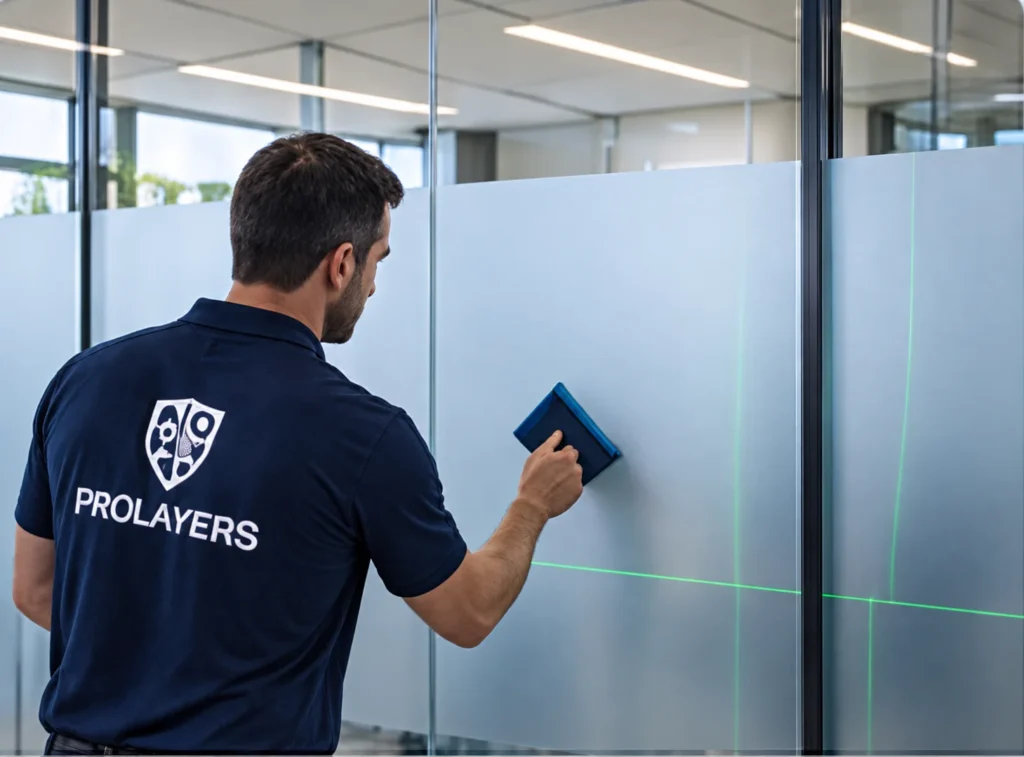
Glass walls can make an office feel bright, modern, and open. But they can also leave meeting rooms, private offices, and work areas too exposed. When full frosting feels too closed and clear glass gives people too little privacy, gradient bands offer a practical middle ground.
Gradient window film adds privacy where people actually need it. It can create a denser or frosted area around important sightlines and then fade into clearer glass. This helps reduce unwanted visibility without covering the entire glass surface.
What Is Gradient Window Film?
Gradient window film is a decorative privacy film that changes gradually from a more private area to a clearer area. Instead of giving the whole glass panel the same level of coverage, it creates controlled privacy across selected sections.
The film gradient can move from bottom to top, from the center outward, or across a selected privacy band. This makes it useful when people need coverage around eye level but still want other parts of the glass to stay visually open.
Where Do Gradient Privacy Bands Work Best?
Partial privacy is useful when the whole room does not need to be hidden. The main goal is to reduce direct sightlines while keeping the space connected, bright, and professional.
Common applications include:
- Conference rooms facing hallways or open work areas
- Private offices with full-height glass walls
- HR, finance, and management rooms
- Reception areas and front desks
- Clinics and consultation rooms
- Coworking spaces with glass dividers
- Internal glass doors and partitions
- Showrooms and customer-facing spaces
The correct privacy height depends on how the room is used. Desks, chairs, doors, meeting tables, corridors, and standing areas can all change where people need coverage.
Why Choose Gradient Film Instead of Full Frost?
Full frosted film can make sense when most or all of the glass needs visual privacy. But many commercial spaces only need to control visibility through one important part of the glass.
A gradient film keeps selected sections clearer while adding privacy across the main viewing area. This gives offices more control without making the entire room feel closed.
Privacy at the Right Height
A privacy band can be positioned around seated eye level, standing eye level, or another important sightline. This works especially well in meeting rooms where people want less visibility during conversations but still like the open-glass design.
Better Use of Natural Light
Clear sections above or below the privacy area allow light to continue moving through the space. You can create useful visual separation without covering every part of the glass.
Softer, More Modern Appearance
A gradient creates a smoother transition between private and clear areas. Instead of a hard visual break, the design can fade gradually and give commercial interiors a clean, professional finish.
Privacy Without Unnecessary Coverage
Not every section of glass needs the same treatment. Partial privacy lets you focus coverage on the views that cause discomfort while leaving other areas open.
Popular Gradient Privacy Layouts
There is no single layout that works for every office. The right design should depend on room use, furniture position, glass size, and normal viewing angles.
Center Privacy Band
A center band places the more private area through the middle of the glass and fades toward clearer sections above and below.
This layout can work well for conference rooms and office partitions because it focuses coverage around the area where seated and standing people are most visible.
Bottom-to-Clear Gradient
This layout provides more coverage toward the lower part of the glass and gradually becomes clearer toward the top.
It can suit reception counters, desk areas, waiting rooms, and other spaces where activity closer to floor or desk level needs greater visual separation.
Partial-Height Frosted Band
A frosted band is not always a true gradient, but it can solve a similar privacy need. Instead of fading gradually, it creates a clearly defined privacy section across the glass.
It can be a good choice when a business prefers a simple and structured appearance.
Our products
Six film families, one for every kind of glass
For office privacy and decorative glass, start with Decorative and Privacy. Every family has its own page with the full range.
- Clarity IR Max
- Nano Ceramic
- Climate IQ 50
- Skyline
- Harmony DR
- Soft Tone
- Eco Silver 20
- X-Clear 70
- X-Eco Silver 15
- X-Hybrid DR 15
- Safety 4 Clear
- Security 8 Clear
- Security 8 Silver
- Security 14 Clear
- X-Safety 7
- AG 6 Clear
- Frost
- White Out
- Black Out
- Poly Layers
- V6 Comfort BLK
- V10 Ceramic IR BLK
- V16 Ceramic IR MAX
- V6 Core
- V10 Reactive
- V16 Velocity
Gradient Window Film vs Full Frosted Film
| Feature | Gradient Window Film | Full Frosted Film |
|---|---|---|
| Privacy coverage | Selected areas and sightlines | Larger or full glass areas |
| Visual openness | Keeps some sections clear | Reduces visibility across the covered area |
| Design | Soft fade or privacy band | Consistent frosted appearance |
| Best suited for | Offices, meeting rooms, partitions | Areas needing broader privacy |
| Placement | Can focus on important viewing heights | Usually covers more of the glass |
| Overall feel | Open with controlled privacy | More enclosed and private |
If activity must be hidden across most of the glass, broader frosted coverage may be the better choice. If you mainly want to block important sightlines while keeping other sections open, a gradient band can be more suitable.
How to Choose the Right Privacy Band Height
A privacy band should not be selected only because it looks good in a sample image. It needs to work with the real room.
Before choosing the final layout, consider:
- Seated eye level from nearby work areas
- Standing eye level in hallways
- Views through office doors
- Desk and meeting table height
- Height and width of each glass panel
- Distance between people and the glass
- Normal indoor lighting
- Level of privacy required
- Existing signs, logos, or glass graphics
For example, a band positioned correctly for people sitting at a conference table may not cover someone standing beside a whiteboard. The design should account for both situations if both matter.
Is Gradient Window Tint the Same as Privacy Film?
The phrase gradient window tint is often used when people are looking for glass that changes from a more private section to a clearer section.
For interior commercial glass, however, the main purpose is normally privacy and appearance rather than simply making the glass darker.
If heat or glare is the main concern, a solar-control film may be more suitable. If unwanted visibility is the main concern, privacy level, opacity, pattern, and placement should guide the selection.
What Gradient Film Can and Cannot Do
A gradient film can reduce direct visibility through selected areas, but it does not automatically make an entire room private. Clear portions of the glass can still allow views into or out of the space.
The final privacy effect can also depend on the film pattern, opacity, viewing distance, lighting, and where the band sits on the glass.
Window film also addresses visual privacy, not sound privacy. If conversations can be heard through the glass wall, adding a privacy film will not soundproof the room.
For rooms handling sensitive conversations, documents, or confidential work, decide first whether partial privacy is enough. If it is not, a fuller frosted or opaque treatment may be more suitable.
Partial Privacy for Conference Rooms
Conference rooms are one of the strongest applications for gradient bands because full-height clear glass can expose everyone sitting around the table.
A correctly placed band can reduce direct views from nearby desks and corridors while keeping clear sections around it.
The goal is not simply to add film. The goal is to identify where people can see into the room and cover those sightlines without adding more privacy material than necessary.
Keep reading
More commercial privacy and decorative guides
Gradient Bands for Private Offices and Workspaces
Private offices can also benefit from selective coverage. Employees may want privacy while working at a desk without completely separating themselves from the surrounding office.
A carefully positioned gradient window film can cover the main work area while allowing clearer glass above or below it.
This approach can also help reduce visual distractions in busy offices where movement outside a glass room constantly attracts attention.
Privacy Film for Reception and Customer Areas
Reception areas often need a balance between openness and separation. Visitors should still feel welcomed, but computer screens, paperwork, and staff activity may not need to remain fully visible.
A partial privacy band can create a visual boundary around the working area while keeping the upper section of the glass open.
The same idea can work in clinics, consultation rooms, showrooms, coworking spaces, and other commercial interiors where complete coverage may feel unnecessary.
Choosing Between a Gradient and a Frosted Band
Choose a gradient when you want the privacy area to transition smoothly into clear glass. This creates a softer visual effect and can fit well with modern office interiors.
Choose a frosted band when you want a clear and defined privacy zone. A straight band can provide a simple appearance and make it easier to separate the private section from the clear section.
Neither option is automatically better. The right choice depends on the room, privacy requirement, interior design, and actual viewing angles.
Choosing Gradient Bands with ProLayers
ProLayers supplies window film solutions for commercial glass projects, while qualified dealers handle installation.
The selection should begin with the privacy need rather than choosing a film only because of its appearance.
A practical process includes:
- Identify which glass areas feel too exposed
- Decide whether partial or full privacy is needed
- Review seated and standing sightlines
- Choose between a gradient, frosted band, or broader privacy treatment
- Match the design to the glass and surrounding interior
- Have a qualified installer confirm measurements and complete the installation
This approach helps prevent unnecessary coverage while making sure important sightlines receive enough privacy.
Get Privacy Without Closing Off the Glass
Too much visibility can make a glass office uncomfortable, but covering every panel is not always necessary.
A carefully planned gradient film can protect important sightlines while keeping the room open, bright, and connected. The key is choosing the right privacy height, coverage style, and film design for the way people actually use the space.
ProLayers supplies commercial window film solutions through its dealer network. Choose the right privacy approach for your glass and have a qualified local dealer complete the installation.
FAQ
Frequently asked questions
Quick answers about gradient window film and partial office privacy.
Still have a question? Ask usDoes gradient window film provide complete privacy?
Not always. It is mainly designed for selective or partial privacy. The denser section can reduce visibility through important sightlines while clearer parts of the glass remain more open. If you need privacy across the whole panel, full frosted or opaque coverage may be more suitable.
Can gradient film be used on conference room glass?
Yes. Conference rooms are a strong use case because the privacy zone can be positioned around the areas where people sit or stand. The rest of the glass can stay clearer when full coverage is not required.
Will gradient film make an office feel dark?
A partial design leaves sections of the glass clearer, which can help maintain the open and bright character of the space. The final appearance will depend on the film style, opacity, glass size, and amount of coverage selected.
Is a gradient better than a frosted privacy band?
It depends on the desired appearance. A gradient provides a softer fade, while a frosted band creates a clearer edge between private and transparent areas. Both can work well when the height and placement match real viewing angles.
Can I use gradient film if I need privacy while sitting and standing?
Yes, but the privacy area needs to be planned for both positions. A band designed only for seated users may leave standing users visible. The installer should review the room layout and important sightlines before the final position is confirmed.
What should I choose if the whole glass wall needs privacy?
If most of the glass needs to block direct views, full frosted or more opaque coverage may be a better choice. Gradient bands are better suited to spaces where you want privacy across selected areas while keeping other sections visually open.
Contact us
Glass too exposed or too plain? Tell us about the space.
Send us which rooms or doors need privacy, how much of the glass you want covered and any branding you have in mind, and we will point you to the right next step.
Contact us-
Visit
12551 Steepleway Blvd SWB B101
Houston, TX 77065 - Hours Mon to Fri 9am to 5pm