COMMERCIAL / Safety & Security
Smash and Grab Window Film: Slow Forced Storefront Entry
Smash and Grab Window Film: Slow Forced Storefront Entry by helping broken glass hold together after impact.
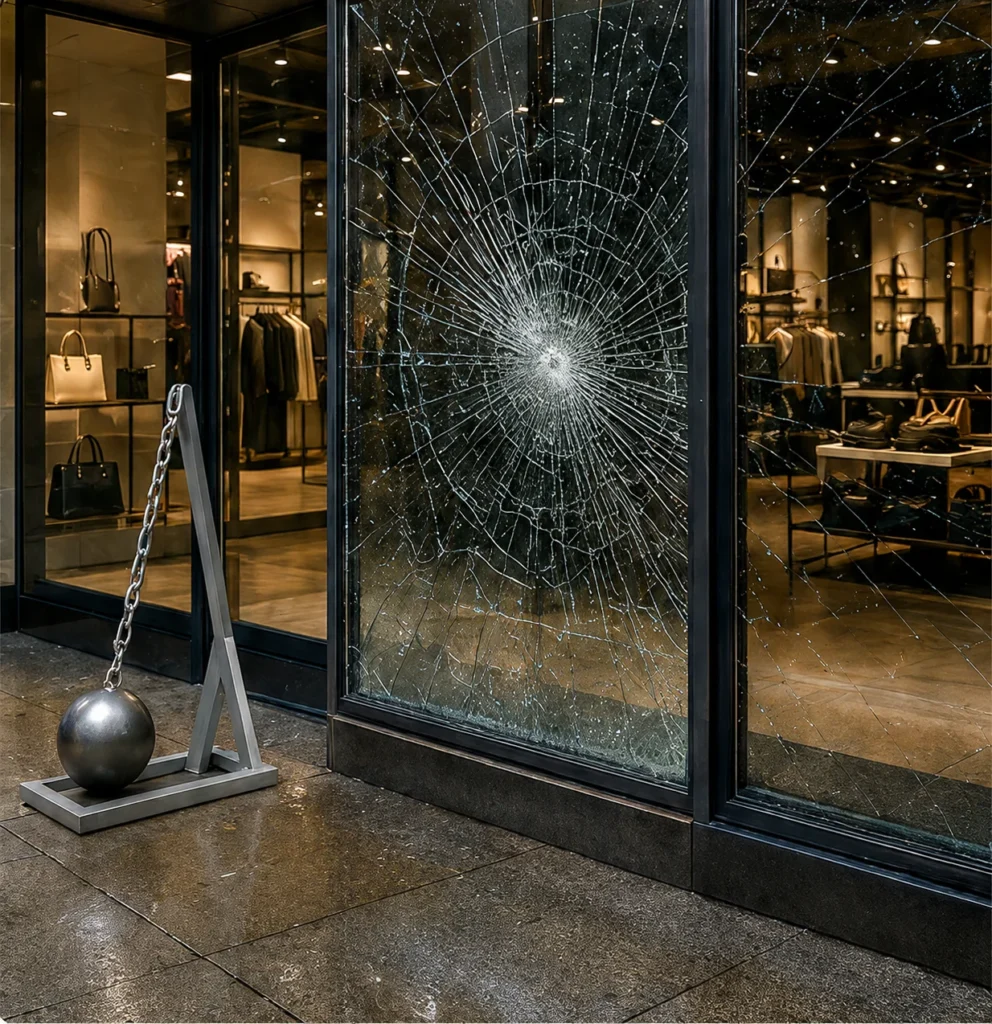
A storefront is designed to make your business visible. Large glass panels help customers see products, displays, and the space inside, but that same visibility can leave exposed glass as an obvious point of attack after business hours.
A smash-and-grab attempt depends on speed. The attacker wants to break the glass, create an opening, reach the merchandise, and leave before there is enough time for a response. Smash and grab window film changes what can happen after the glass is struck.
Instead of promising unbreakable glass, security film is designed to help broken glass stay together. That can make it harder to create a quick, clean opening through a storefront window or glazed door.
The purpose is not to make glass impossible to break. It is to make rapid entry through broken glass more difficult.
What Does Smash and Grab Window Film Actually Do?
Security window film is applied to suitable existing glass to create a stronger bonded surface. If the glass breaks, the film can help retain the fractured pieces instead of allowing them to immediately separate and fall away.
The glass itself may still crack. The important difference is what happens after that first impact. An attacker may now have to continue working against a damaged pane instead of stepping through an immediate opening. That extra resistance can disrupt the fast-entry approach that smash-and-grab theft relies on.
For a retail owner, property manager, facility manager, or security consultant, that is the real value of smash and grab window film: adding another layer between impact and access.
Why Storefront Security Is About Time, Not Just Glass Strength
A security plan should not be based on the idea that one product will stop every possible attack. Different tools protect a building in different ways.
Alarms can identify an incident. Cameras can record activity. Access-control systems protect controlled entrances. The security film focuses on one specific weakness: what happens when exposed glazing is attacked.
The longer it takes to turn broken glass into an accessible opening, the less convenient a fast smash-and-grab attempt becomes. That is why storefront security should be viewed as a system rather than a single product.
Film Alone and Film With a Frame Attachment System
One of the most important details is often overlooked: holding broken glass together and holding that entire broken pane within the opening are not exactly the same thing.
For applications with greater forced-entry concerns, the relationship between the film, glass, frame, and attachment method can become important.
| Security Consideration | Standard Film Application | Film With Attachment System |
|---|---|---|
| Helps retain broken glass | Yes | Yes |
| Adds resistance after impact | Yes | Yes |
| Connects filmed glass more directly to the frame | No dedicated structural attachment | Designed to provide additional retention at the frame |
| Suitable approach | Depends on glass and project requirements | May be considered where stronger opening retention is required |
| Final selection | Based on complete glazing conditions | Based on complete glazing conditions and security goals |
No table can determine the correct system for every storefront. Existing glass type, framing, exposed edges, window construction, building use, and the expected threat should all be considered before a product is selected.
Security Film Is Not the Same as Ordinary Commercial Tint
A commercial window tint roll may be made primarily for solar heat control, glare reduction, appearance, privacy, decorative use, safety, security, or a combination of functions. A dark-looking film should never be assumed to provide meaningful forced-entry performance simply because it is thicker-looking or less transparent.
The same applies when comparing commercial window tinting films online. Product purpose matters more than appearance. If smash-and-grab protection is the goal, the conversation should begin with safety and security performance, glass compatibility, framing conditions, and the intended system design.
Our products
Six film families, one for every kind of glass
For commercial glass safety and security, start with Safety and Security. Every family has its own page with the full range.
- Clarity IR Max
- Nano Ceramic
- Climate IQ 50
- Skyline
- Harmony DR
- Soft Tone
- Eco Silver 20
- X-Clear 70
- X-Eco Silver 15
- X-Hybrid DR 15
- Safety 4 Clear
- Security 8 Clear
- Security 8 Silver
- Security 14 Clear
- X-Safety 7
- AG 6 Clear
- Frost
- White Out
- Black Out
- Poly Layers
- V6 Comfort BLK
- V10 Ceramic IR BLK
- V16 Ceramic IR MAX
- V6 Core
- V10 Reactive
- V16 Velocity
Can Security Film Keep a Storefront Looking Professional?
Security does not automatically mean turning an attractive storefront into a closed or heavily obstructed facade. Depending on the product selected, security-focused film can maintain a clean commercial appearance while working with the existing glass.
This can be valuable for retailers that depend on window displays, product visibility, natural daylight, or an open architectural design. Some commercial projects may also have separate requirements for heat, glare, UV exposure, or privacy.
Those needs should be discussed alongside the security requirement rather than assuming one generic film will handle everything equally well. The priority should always remain clear: choose the film for the job it is expected to perform.
Where Smash-and-Grab Window Film Can Make Sense
Businesses with accessible ground-floor glazing may want to consider security film as part of a broader storefront protection plan.
Common applications include:
- Retail stores with products displayed close to exterior glass
- Showrooms with large street-facing windows
- Commercial entrances and glazed doors
- Ground-floor offices with accessible exterior windows
- Pharmacies and other businesses holding valuable inventory
- Shopping-center storefronts exposed after closing
- Interior glass areas where broken-glass retention is important
The correct approach can vary even between two businesses in the same building. A small glazed door, a large display window, and a full-height storefront may have very different framing and glass conditions.
What Should Be Checked Before Choosing a Security Window Film?
A good security-film decision begins with the existing glazing rather than with a product name.
The glass type should be identified. The frame and glazing system should be inspected. The exposed areas of the storefront should be considered. The business should also define whether its main concern is accidental breakage, glass retention, smash-and-grab theft, more serious forced entry, or several risks at once.
This prevents an important mistake: choosing a general-purpose tint when the project actually requires a security-focused glazing solution.
It also helps determine whether a standard film application is appropriate or whether an attachment system should be considered as part of the design.
Keep reading
More commercial safety and security guides
Why Buying the Thickest-Looking Film Is Not Enough
Customers often expect security film selection to be simple: choose a heavy film, apply it to the glass, and the storefront is protected. Real commercial glazing is more complicated.
A film works as part of the glass assembly. The condition of the glass, film construction, frame, edge treatment, attachment method, and installation quality can all influence how the system behaves after impact.
For that reason, the best question is not, “What is the strongest roll?” A better question is, “What film system is appropriate for this glass, frame, and security requirement?”
That approach reduces guesswork and makes the specification easier to defend.
Security Film Should Support the Rest of Your Storefront Protection
Smash and grab window film works best when it is treated as one part of the security plan rather than the entire plan. Lighting, cameras, alarms, inventory placement, access control, door hardware, exterior visibility, and glazing security can all address different parts of the same risk.
The film focuses on the glazing itself. Its job is to help prevent broken glass from becoming an easy opening immediately after impact. That makes it especially relevant for businesses that want to improve an existing storefront without automatically replacing every suitable glass panel.
Build a Storefront That Is Harder to Enter Quickly
If your storefront depends on large areas of exposed glass, simply replacing a broken pane after every incident does not address the original weakness.
Smash and grab window film provides a retrofit option that can help broken glass remain together and make a rapid opening more difficult to create.
The next step is not choosing a random roll from a product list. Start with the storefront itself: the glass, frame, exposure, appearance requirements, and level of security you are trying to achieve.
ProLayers supplies professional window film solutions through its dealer network. Product selection should be matched to the actual glazing system, and installation should be completed by a qualified installer familiar with the selected film and application.
FAQ
Frequently asked questions
Quick answers about smash and grab window film for storefronts.
Still have a question? Ask usWhat About the Search Term “Time Tint”?
If you have seen the phrase time tint while researching storefront film, do not use the wording alone to select a security product. Tint shade and forced-entry resistance are different considerations. A film that changes the appearance of a window is not automatically a security film, while a security-focused product does not necessarily need to make the storefront noticeably darker. When security is the goal, focus on the film's intended application and the complete glazing system rather than a generic tint term.
Can a Commercial Window Tint Roll Be Used for Smash-and-Grab Protection?
Not every commercial window tint roll is designed for security. Solar-control film may help with heat or glare. Decorative film may change appearance or privacy. Safety and security film is intended for a different purpose. Using the wrong type of commercial window tinting film simply because it fits the glass does not turn it into a forced-entry solution. The product should be selected according to the glazing, project requirements, and intended performance.
Does Smash and Grab Window Film Make Glass Unbreakable?
Security film should not be sold as unbreakable glass or as a guarantee that nobody can enter a building. Enough force, tools, time, or repeated attack can defeat many physical security measures. Its value is in changing the behavior of broken glass and making rapid access more difficult. That distinction matters because realistic security planning is more useful than exaggerated promises.
Does Frame Attachment Matter?
Film can help broken glass remain bonded together, while an attachment system can help connect the filmed glass to the surrounding frame. For locations with greater forced-entry concerns, that relationship may be an important part of the overall system. The appropriate configuration depends on the existing storefront construction and the protection objective.
Will Security Film Make My Storefront Look Dark?
Security and tint darkness are separate characteristics. A storefront should be evaluated based on the security requirement and the desired visual appearance before a film is selected. Businesses that rely heavily on product displays or clear street visibility should make appearance part of the specification from the beginning.
Should Security Film Replace Alarms, Cameras, or Other Security Measures?
Window film addresses the glazing. Other systems address detection, monitoring, access, communication, and response. A stronger storefront strategy uses the right measure for each part of the risk instead of expecting one product to perform every security function.
Contact us
Worried about exposed glass? Tell us about the building.
Send us which glass worries you most, the type of doors and frames and what you want to protect against, and we will point you to the right next step.
Contact us-
Visit
12551 Steepleway Blvd SWB B101
Houston, TX 77065 - Hours Mon to Fri 9am to 5pm