PROFESSIONAL / Building Envelope & ENERGY
Thermal Stress and Glass Compatibility
Thermal Stress and Glass Compatibility: why film is a risk on annealed glass and not on tempered, and the checks that settle it.
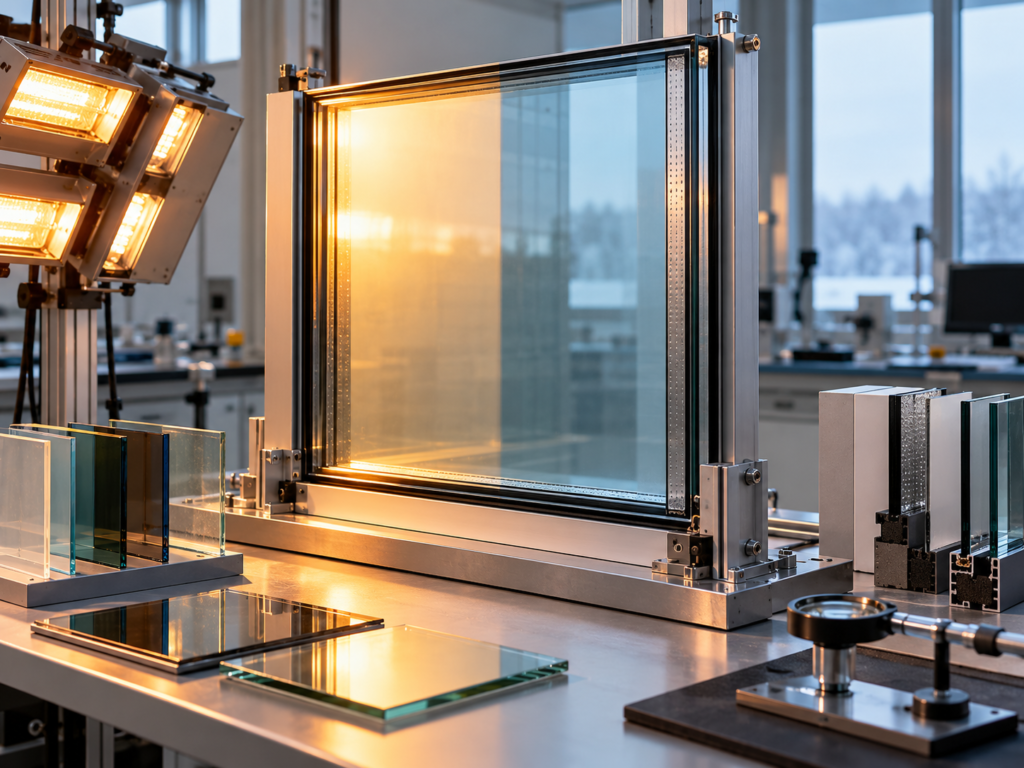
Thermal Stress and Glass Compatibility: Which Glass Carries the Risk
The single most useful fact in this whole subject is that the risk depends far more on what the glass is than on what the film is.
| Glass type | Temperature differential it tolerates in good condition | Position on applied film | What that means on site |
|---|---|---|---|
| Fully tempered | About 250 °C for thermally toughened glass | Architecturally it will not see excess thermal stress except in a fire | Film can be installed without further thermal stress assessment |
| Heat-strengthened | Between tempered and annealed | Excessive thermal stress is highly unlikely | Film is usually acceptable after checking for high-stress conditions |
| Annealed float | About 40 °C | Most at risk, and the type film can most easily push over the limit | A full film-to-glass compatibility assessment before specifying |
| Rough cast | About 30 °C | Lower tolerance than float | Treat as higher risk than annealed and assess |
| Wired, polished or cast | About 25 °C | The lowest tolerance of the common types | Assess, and expect many films to be unsuitable |
Those differentials assume glass in good, undamaged condition and compliant with the relevant standards. Damaged glass fails lower, which is why edge condition gets its own section further down this page.
The Mechanism, and the Numbers Behind It
Thermal stress is not a property of film. It is a property of unevenly heated glass, and film is one of several things that can make the heating more uneven.
Solar energy is the single major cause of temperature difference in glass. The centre of a pane in sun warms quickly. The edges, held in the frame and shaded by it, warm far more slowly. The warm centre expands against cool edges, and the edges go into tension. Thermal breakage occurs when those tensile stresses exceed the strength of the glass edge.
The arithmetic is unforgiving and easy to follow. On annealed glass with a clean cut edge, the edge resists roughly 2,400 psi, and every 1 °F of differential across the pane produces around 50 psi of stress. So a pane with its edge at 70 °F and its centre at 120 °F, a 50 °F differential, generates about 2,500 psi. That is past what the edge can hold, and the pane breaks.
Two conclusions follow directly. First, nothing about this requires an extreme climate: a 50 degree differential is an ordinary sunny day on a cold morning. Second, every factor that raises centre temperature or lowers edge temperature moves the pane toward that threshold, which is the framework for everything else on this page.
It is worth saying plainly that the risk can never be reduced to zero. Glass is a brittle material with natural variation, and the honest objective is to keep the calculated stress well inside what the specific glass can take.
Why Film Changes the Equation
A film changes how much of the incoming solar energy ends up as heat in the glass itself.
The property that matters is solar energy absorption. Transmission and reflection send energy onward or back outside. Absorbed energy stays in the film and the glass as heat, raising centre temperature while the framed edges stay where they were.
Which is why the guidance on this is blunt: film can significantly increase the risk of thermal stress breakage of float glass if it is incorrectly specified. Not film in general, and not on every glass. Incorrectly specified film, on the type of glass that has the least headroom.
A related point catches experienced people out. The same film behaves differently on different glazing systems, so a product that has been installed without incident on thousands of square feet of one construction tells you very little about its behaviour on another. The assessment is of the film and the glass together, every time.
Insulated units deserve particular care
On a sealed unit there is more at stake than the pane. efficientwindows.org notes that because film absorbs solar heat it can raise glass temperature and “may cause thermal stress on the glass or insulated glazing seals”, particularly on sunny but cold days, and advises checking whether application affects the existing window warranty. Those are two separate exposures, one physical and one contractual, and both belong in the conversation before anyone quotes.
Our products
Six film families, one for every kind of glass
For solar control matched to your glass, start with Architectural Solar Control. Every family has its own page with the full range.
- Clarity IR Max
- Nano Ceramic
- Climate IQ 50
- Skyline
- Harmony DR
- Soft Tone
- Eco Silver 20
- X-Clear 70
- X-Eco Silver 15
- X-Hybrid DR 15
- Safety 4 Clear
- Security 8 Clear
- Security 8 Silver
- Security 14 Clear
- X-Safety 7
- AG 6 Clear
- Frost
- White Out
- Black Out
- Poly Layers
- V6 Comfort BLK
- V10 Ceramic IR BLK
- V16 Ceramic IR MAX
- V6 Core
- V10 Reactive
- V16 Velocity
What a Film-to-Glass Compatibility Assessment Examines
Compatibility is not a yes or no property of a film. It is the result of a list of inputs, most of which describe the building rather than the product.
A proper assessment is a calculation about a specific pane in a specific place, and it takes in all of the following:
- The film’s solar energy transmission, reflection and absorption
- Glass type, colour and any coatings
- Glass thickness
- Glazing type and construction, including whether it is a sealed unit
- Pane size
- External shading
- Backup materials behind the glass, such as blinds and curtains
- Frame type
- Altitude and solar energy intensity
Notice how few of those are properties of the film. The film contributes one line. Everything else is a description of the installation, which is the reason a survey comes before a specification rather than after it.
Manufacturers, distributors and installers will normally carry out this assessment, and most will do it as part of quoting. The output to ask for is a written confirmation that the proposed film is suitable for that glass in that application, not a general assurance that the product is widely used.
Edge Quality: The Variable Nobody Photographs
Every number in this subject carries a silent qualifier, and this is it.
The resistance figures quoted anywhere, including on this page, assume glass in good undamaged condition. A clean cut edge on annealed glass resists on the order of 2,400 psi. A chipped, scuffed or vented edge does not, and nothing on the outside of the pane will tell you which one you are looking at.
This is why breakage at stresses below the expected threshold is so often traced back to damage rather than to the calculation being wrong. Surface and edge damage from installation, or from other trades working nearby after glazing, substantially reduces the resistance the glass actually has.
Two practical habits follow. Inspect edges and surfaces before committing to a film, particularly on older glazing that has been reglazed, repaired or worked around. And record what you found, because if a pane does break later, the question of pre-existing damage will be asked and nobody will be able to answer it from memory.
Shade Patterns and Other Conditions That Raise Stress
Thermal stress failures happen on buildings with no film on them at all.
Before any film is considered, a number of ordinary site conditions push glass toward its limit by creating uneven heating. They are worth knowing because they decide whether a given pane has headroom left for a film at all.
- Partial shading. Overhangs, fins or any element that shades only part of the glass create a hot zone next to a cool one. Heat-treated glass is required where this occurs.
- Interior window treatments fitted too tightly. Blinds and curtains trap heat against the glass unless air can move. Clearances of about 1-1/2 ″ (38 mm) at the bottom, 1-1/2 ″ at one side or the top, and 2 ″ (50 mm) from the glass allow that movement.
- Heating or cooling outlets on the wrong side. Elements placed on the glass side of a window treatment rather than the room side drive local temperature differences directly.
- Scaffolding. It casts moving shade patterns across glazing for the duration of the works.
- Storage in sun. Partial or full sun exposure on stacked glass before installation.
- Overnight cooling of framing before a building is brought up to temperature.
- Adjacent trades. Welding, painting or concrete work after installation, and protective materials applied over glass by others.
- Spandrel cavities. Elevated cavity temperatures, with at least 1 ″ clearance recommended between glass and insulation.
The relevance to film work is direct. A pane already subject to several of these has little margin left, and adding an absorbing film is precisely the wrong move. A pane with none of them, in heat-treated glass, has a great deal of margin.
The Pre-Installation Checklist
Everything above reduces to a short list of things to establish before a film is ordered, let alone applied.
| Check | Why it matters | How to settle it |
|---|---|---|
| Glass type: annealed, heat-strengthened or tempered | It determines whether an assessment is needed at all | Glazing records, a glass identification meter, or the manufacturer |
| Monolithic or sealed unit, and any coatings | Construction changes the thermal behaviour and the seal exposure | Survey, plus the original glazing specification where it exists |
| Pane sizes and frame type | Both feed directly into the stress calculation | Measured on site |
| Edge and surface condition | Damage lowers resistance below every published figure | Visual inspection, recorded before work starts |
| Shading patterns across the glass | Partial shade creates the hot and cool zones that cause failures | Observe at the times of day the elevation is in sun |
| Blinds, curtains and internal obstructions | They trap heat against the glass if clearances are tight | Measure clearances and note what is fitted |
| Written compatibility confirmation for this film on this glass | It is the only document that actually answers the question | Request from the manufacturer or distributor before ordering |
Seven checks, none of which take long, and together they turn a judgement call into a documented decision.
Keep reading
More on building envelope and energy
Reading a Break After the Fact
When a pane cracks on a building with film on it, the film gets blamed immediately. The fracture itself usually says whether that is fair.
A thermal stress fracture in float glass has a recognisable signature:
- The origin sits away from the corners, typically somewhere along an edge.
- The fracture lines meet the glass edge and the glass surface at 90 degrees.
- A high-stress break shows the same features plus small additional fracture lines on either side of the break, also at 90 degrees.
The diagnostic value runs mostly in one direction. A crack showing all of these characteristics is likely to be thermal stress. A crack missing any of them is not thermal stress, and the usual alternative explanation is physical damage, which is also the common cause of breakage at stress levels below the expected threshold.
If a pane does break on a filmed elevation, photograph the fracture before anything is removed, including a clear shot of the origin and the edge. That evidence settles the question quickly, and it settles it either way, which is the point.
What This Means in Practice
Five habits separate a professional installation from an expensive one.
Survey before specifying. Glass type, construction, coatings, sizes, edge condition, shading and internal obstructions. A performance target chosen before any of that is known is a guess.
Get the compatibility confirmation in writing, for this glass. General assurances about a product are not an assessment, and the file needs the specific answer.
Say what the warranty position is. Both the film warranty and the client’s existing window warranty, which applying film may affect.
Record the condition you found. Photographs of edges and surfaces before work, kept with the job file.
Be willing to decline a pane. On annealed glass with partial shading, tight blinds and a high absorption film, the right answer is sometimes a different film or no film on that elevation. That conversation is cheaper than a replacement and far cheaper than a dispute.
Specify From the Glass Outward
Nothing on this page is a substitute for a compatibility assessment of the actual installation.
Thermal stress is a solved problem in the sense that the mechanism is understood, the inputs are known and the calculation exists. It remains a live problem because the inputs are site specific and the assessment is easy to skip.
The underlying fact is simple enough to hold in your head. Film adds absorbed heat to the centre of a pane whose edges stay cool. On tempered glass there is enormous headroom. On annealed float there is roughly 40 °C of it, less if the glass is damaged, and a badly chosen film can consume it.
ProLayers supplies architectural and automotive window film through its dealer network. A dealer can identify the existing glazing, carry out the film-to-glass compatibility assessment for the specific installation, and confirm suitability in writing before any film is ordered.
Suggested product: Safety 4 Clear. UV protection with almost no change in appearance. View the product
FAQ
Frequently asked questions
Six quick answers about thermal stress and window film.
Still have a question? Ask usCan window film break glass?
Film does not break glass by itself, but it absorbs solar energy, and absorbed energy raises the temperature of the glass while the framed edges stay cooler. On annealed float glass an incorrectly specified film can significantly increase the risk of thermal stress breakage. On fully tempered glass, architecturally, the glass will not see excess thermal stress except in a fire.
How much temperature difference does it take?
On annealed glass with a clean cut edge, the edge resists roughly 2,400 psi and each 1 degree Fahrenheit of differential adds about 50 psi. A 50 degree differential, for example an edge at 70 and a centre at 120, produces about 2,500 psi, which is enough to break it. Published tolerances for undamaged glass are around 40 degrees Celsius for annealed float and about 250 degrees Celsius for thermally toughened glass.
Do I need an assessment on tempered glass?
Generally no. Guidance is that tempered glass will not be exposed to excess thermal stress in architectural use except in a fire, and film can be installed without further thermal stress assessment. Heat-strengthened glass is highly unlikely to see excessive thermal stress, and film is usually acceptable after checking for conditions that would cause high stress.
What does a compatibility assessment look at?
The film’s solar transmission, reflection and absorption, then the glass type, colour and coatings, thickness, glazing construction, pane size, external shading, backup materials such as blinds and curtains, frame type, and altitude and solar intensity. Only the first of those is a property of the film.
Why did a pane break when the same film is fine elsewhere in the building?
Because the assessment is of the film and the glass together. The same film behaves differently on different glazing systems, and factors such as pane size, shading pattern, internal blinds and edge condition vary between elevations and between openings.
How can I tell whether a break was thermal stress?
A thermal stress fracture in float glass typically originates away from the corners, with fracture lines meeting the glass edge and surface at 90 degrees, and a high-stress break adds small fracture lines either side at 90 degrees. A crack without those characteristics is not thermal stress, and physical damage is the usual alternative explanation.
Contact us
Specifying film for a project? Tell us about the glazing.
Send us the glass type, the elevation and the performance you need, and we will point you to the right next step.
Contact us-
Visit
12551 Steepleway Blvd SWB B101
Houston, TX 77065 - Hours Mon to Fri 9am to 5pm