COMMERCIAL / Safety & Security
Commercial Building Window Tinting for Storm & Debris
Commercial Building Window Tinting for Storm & Debris: safety film that helps hold broken glass together after impact.
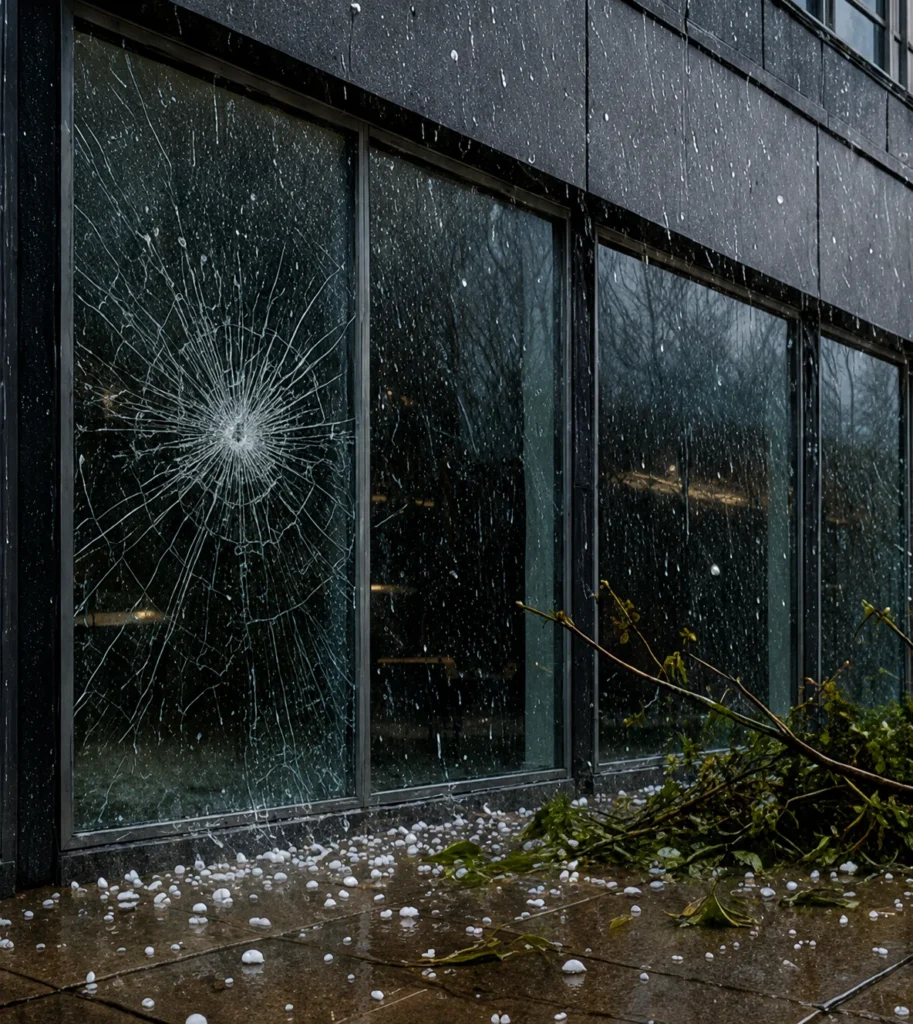
Storms can turn large commercial glass areas into a serious concern. Strong winds, hail, tree branches, loose materials, and other wind-borne debris may strike windows with little warning. Even when a window does not fail immediately, damaged glass can create safety, cleanup, security, and business-continuity concerns.
Safety and security window film gives businesses another way to strengthen their existing glazing strategy. It is designed to help hold broken glass together after impact, reducing the chance of loose glass fragments spreading through occupied areas.
For offices, retail stores, schools, healthcare facilities, hotels, public buildings, and other commercial properties, the right window film system can add an important layer of protection without completely changing the appearance of the building.
When Storm, Hail, and Wind-Borne Debris Put Commercial Glass at Risk
Commercial buildings often use large windows, glass doors, storefront glazing, and curtain-wall systems. These surfaces bring in daylight and create an open appearance, but they can also become exposed points during severe weather.
Storm-related glass damage may be caused by:
- Strong wind carrying loose outdoor objects
- Tree branches and small debris striking windows
- Hail hitting exposed glazing
- Objects moved by sudden wind gusts
- Pressure changes during severe weather
- Existing glass damage becoming worse during a storm
- Broken exterior glass leaving interior areas exposed
The concern is not only whether the glass breaks. What happens after breakage also matters.
Loose fragments may fall inward or outward, interior spaces can become exposed, and damaged openings may affect normal business operations. This is why storm preparation should consider the complete glass area rather than only the appearance of the window.
How Safety Window Film Helps After Glass Breakage
Safety and security film is applied to compatible glass to create a stronger relationship between the film and the glass surface.
If an impact causes the glass to break, the film can help keep many of the broken pieces together instead of allowing them to separate as easily. The goal is not to make ordinary glass impossible to break. The goal is to improve how the glazing behaves when breakage happens.
This can be especially valuable in occupied commercial environments where large amounts of glass are close to employees, customers, students, residents, visitors, or valuable interior property.
Key reasons businesses consider safety window film include:
- Helping retain broken glass fragments
- Reducing loose flying-glass concerns
- Adding another protective layer to existing glazing
- Supporting safer glass management in high-traffic areas
- Improving protection without replacing every window
- Keeping a clean architectural appearance
- Creating a more complete commercial safety strategy
The exact film and system should be selected according to the existing glass, frame, building conditions, and intended purpose.
Safety Film Is Different From Standard Commercial Tint
Not every window film is designed for the same job.
Standard commercial building window tinting is often selected for solar control, glare management, appearance, privacy, or occupant comfort. Safety and security film is selected when glass retention and protective performance are part of the project requirements.
Understanding this difference is important when comparing commercial window solutions.
| Window Goal | Common Film Category | Main Purpose |
|---|---|---|
| Heat and glare control | Solar control window film | Helps manage sunlight, glare, and indoor comfort |
| Office privacy | Privacy or decorative film | Changes visibility through interior or exterior glass |
| Frosted appearance | Commercial window frosting | Creates privacy or an etched-glass appearance |
| Broken-glass retention | Safety and security film | Helps keep broken glass together after breakage |
| Storm-related glass concerns | Safety/security glazing solution | Adds protection for glass exposed to impact and debris |
A building may have several different window needs at the same time. For example, an office may need privacy in conference rooms while exterior glass requires a safety-focused solution.
One film should not automatically be expected to solve every glazing requirement.
Storm Protection Should Start With the Existing Glass System
Choosing film based only on thickness, appearance, or a product name can lead to the wrong solution.
Commercial glazing systems vary widely. A storefront, office tower, school entrance, warehouse office, hotel lobby, and healthcare facility may all use different types of glass and framing.
Before selecting a safety film, several factors should be reviewed.
A. Existing Glass Type
The existing glass affects what film options may be appropriate.
Glass configuration, condition, size, and location should be considered before a film is selected. This is especially important on large commercial windows or glazing that already experiences high solar or environmental exposure.
B. Window and Door Frames
The frame is another part of the system.
In some applications, an attachment system may be considered to help connect the filmed glass more securely with the surrounding frame. The correct approach depends on the glass system, frame construction, project requirements, and intended level of protection.
C. Building Exposure
A sheltered interior window does not face the same conditions as exterior glass directly exposed to severe weather.
Building orientation, surrounding structures, open areas, local weather exposure, and the position of the glass should all be considered during product selection.
D. Purpose of the Film
The required solution should match the actual reason for upgrading the glass.
A property owner may be focused on storm damage, accidental breakage, security, privacy, glare, solar control, or several needs together. Defining the priority first makes it easier to select the correct film category.
Our products
Six film families, one for every kind of glass
For commercial glass safety and security, start with Safety and Security. Every family has its own page with the full range.
- Clarity IR Max
- Nano Ceramic
- Climate IQ 50
- Skyline
- Harmony DR
- Soft Tone
- Eco Silver 20
- X-Clear 70
- X-Eco Silver 15
- X-Hybrid DR 15
- Safety 4 Clear
- Security 8 Clear
- Security 8 Silver
- Security 14 Clear
- X-Safety 7
- AG 6 Clear
- Frost
- White Out
- Black Out
- Poly Layers
- V6 Comfort BLK
- V10 Ceramic IR BLK
- V16 Ceramic IR MAX
- V6 Core
- V10 Reactive
- V16 Velocity
Where Storm and Safety Window Film Can Be Used
Commercial properties can contain hundreds or even thousands of square feet of glass. Replacing every existing window may not always match the scope of a retrofit project.
Safety window film gives property teams another option to consider for suitable existing glazing.
Common applications include:
- Office buildings
- Corporate facilities
- Schools and universities
- Healthcare and clinic buildings
- Retail storefronts
- Restaurants
- Hotels and hospitality properties
- Multifamily common areas
- Government and municipal buildings
- Places of worship
- Warehouses and industrial facilities
- Auto dealerships and showrooms
- Banks and financial branches
- Gyms and fitness studios
- Senior living facilities
- Ground-floor commercial spaces
Each property should be assessed according to its own glazing, exposure, occupancy, and safety goals.
Commercial Office Window Tinting for Occupied Workspaces
Office windows are not only part of the exterior design. They directly affect the spaces where employees work, meet, and move throughout the day.
Large exterior windows may be close to desks, conference rooms, waiting areas, corridors, or reception spaces. When severe weather affects the glass, these occupied zones may become part of the risk area.
A safety-focused commercial office window tinting strategy can help property managers address vulnerable glazing while keeping the overall appearance professional.
Depending on the project, businesses may also have separate goals such as:
- Reducing screen glare
- Managing strong sunlight
- Improving privacy in meeting rooms
- Creating visual separation on interior glass
- Maintaining exterior appearance
- Supporting existing safety planning
These requirements should be considered together instead of selecting a film based on only one feature.
What About Commercial Window Frosting?
Frosted film and safety film solve different needs.
Commercial window frosting is normally used when privacy, visual separation, branding, or an etched-glass appearance is the priority. It can be useful for conference rooms, private offices, reception areas, glass partitions, and other spaces where clear visibility is not wanted.
Storm-related applications require a different conversation.
If both privacy and safety are required on the same glass, the complete glazing requirement should be reviewed before choosing the film. The appearance of a product does not automatically indicate its protective purpose.
This distinction helps businesses avoid choosing a decorative solution when a safety-focused product is actually needed.
Is “Wind Tint” the Same as Storm Window Film?
People sometimes use terms such as wind tint when searching online for window film that may help with strong wind or storm-related glass concerns.
In commercial glazing, however, standard window tint and safety film are not the same thing.
A normal solar tint may be selected for heat, glare, or appearance. A storm-focused project should be evaluated around safety and security film, the existing glass, framing, and the conditions the building may face.
Using the correct product category is important because visual darkness alone does not tell you how a film is intended to perform.
Film Alone Should Not Be Treated as an Unbreakable Barrier
Safety film adds another layer to a glazing system, but it should not be described as making glass unbreakable.
Severe weather can create different types and levels of impact. Glass type, frame condition, impact direction, object size, building construction, and other factors can influence what happens during an event.
A professional recommendation should therefore focus on the complete application rather than making unrealistic promises.
For a commercial property owner, the better question is:
- “What window film system fits my existing glass and the type of risk I want to address?”
That question leads to a much more useful product recommendation than simply asking for the darkest, thickest, or strongest-looking tint.
Keep reading
More commercial safety and security guides
Safety Film vs Replacing Existing Commercial Glass
Window replacement and window film are different approaches.
Full glass replacement changes the glazing unit itself. Window film works with compatible existing glass and may be considered when a building owner wants to upgrade specific glazing characteristics without automatically replacing every window.
Safety Window Film May Be Considered When:
- Existing glass is suitable for film
- A retrofit solution is preferred
- Broken-glass retention is a priority
- Large areas of commercial glazing need evaluation
- Building appearance should remain largely unchanged
- Property teams want to upgrade selected areas
Glass Replacement May Be Considered When:
- Existing glass is damaged
- Frames or glazing systems require major repair
- The project requires a different glass construction
- The complete façade is already being replaced
- Film is not suitable for the existing glazing
The correct route depends on the building, glass, frame, and project requirements.
A Better Approach for Commercial Storm Preparation
Window film should be one part of a wider building-safety plan.
Facility managers should identify exposed glazing, understand which spaces remain occupied during severe weather, review the condition of windows and frames, and determine where broken glass could create the greatest disruption.
A practical review can include:
- Identify large or highly exposed glass areas.
- Review existing glass and framing.
- Define the main concern: storms, debris, security, accidental breakage, or multiple risks.
- Determine whether privacy or solar control is also required.
- Match the film category to the actual project goal.
- Use an experienced dealer to evaluate the application.
- Keep product and project documentation for future facility management.
- This process creates a more useful specification than choosing film from appearance alone.
Why Businesses Choose ProLayers
Commercial window film projects often involve more than selecting a shade from a sample card.
ProLayers supplies window film solutions for commercial properties with different glazing needs, including safety, security, solar control, privacy, decorative, and exterior applications.
The goal is to help dealers and property teams match the film category with the actual use of the glass.
ProLayers does not position normal tint as a substitute for every type of protective glazing. The correct solution depends on the project, which is why glass type, building conditions, desired appearance, and intended use should all be considered.
ProLayers supplies the film. Qualified dealers handle the installation.
Prepare Commercial Glass Before the Next Severe Weather Event
Storms rarely arrive at a convenient time.
If your building has large exterior windows, storefront glass, glass doors, or occupied areas close to exposed glazing, reviewing those surfaces before severe weather can help you make a better safety decision.
The right solution starts with understanding the existing glass and choosing film for the actual risk, not simply selecting a darker tint.
ProLayers supplies commercial window film solutions through a dealer network so businesses can connect with professionals who can evaluate their glazing and recommend the appropriate option.
FAQ
Frequently asked questions
Quick answers about commercial window film for storms, hail and debris.
Still have a question? Ask usCan window film stop hail from breaking commercial glass?
Safety window film should not be treated as a guarantee that hail or another impact will never break the glass. Its value is in helping improve the behavior of compatible glazing and helping retain broken glass after breakage. The correct film should be selected according to the specific glass system and project requirements.
Does safety film make a commercial window unbreakable?
No. Glass can still break when exposed to sufficient force. Safety film is intended to add another protective layer and help hold broken glass together rather than make the window impossible to break.
Can safety window film help with wind-borne debris?
Safety and security film can be considered when wind-driven debris and broken-glass retention are concerns. The complete application should be reviewed because glass type, framing, building exposure, and the selected film system all matter.
Is safety film the same as normal commercial window tint?
No. Normal commercial tint may focus on solar heat, glare, appearance, or privacy. Safety and security films are selected when glass retention and protective performance are part of the project goal.
Can privacy and safety requirements be addressed on the same project?
Yes, a commercial building can have both requirements. Some areas may need privacy film, while exterior or high-risk glass may require a safety-focused solution. Product selection should be based on the purpose of each glass area rather than applying one film throughout the entire building.
Do all commercial windows need the same safety film?
Not necessarily. Different elevations, glass types, window sizes, frames, and building uses can create different requirements. A project should be reviewed by area rather than assuming every window needs the same solution.
Is safety film only useful for exterior glass?
Exterior glazing is an important application, but safety concerns can also exist around interior glass, doors, partitions, entrances, and other high-traffic areas. The right film depends on the reason for protecting the glass.
Will storm film change the appearance of my building?
That depends on the product selected. Safety-focused window films are available for different architectural requirements, so appearance should be discussed together with the protective goal before a product is chosen.
Contact us
Worried about exposed glass? Tell us about the building.
Send us which glass worries you most, the type of doors and frames and what you want to protect against, and we will point you to the right next step.
Contact us-
Visit
12551 Steepleway Blvd SWB B101
Houston, TX 77065 - Hours Mon to Fri 9am to 5pm