COMMERCIAL / Safety & Security
Safety Glazing Codes: Avoid ANSI Z97.1 & CPSC Compliance Gaps
Safety Glazing Codes: Avoid ANSI Z97.1 & CPSC Compliance Gaps by matching tested film and glass to the required rating.
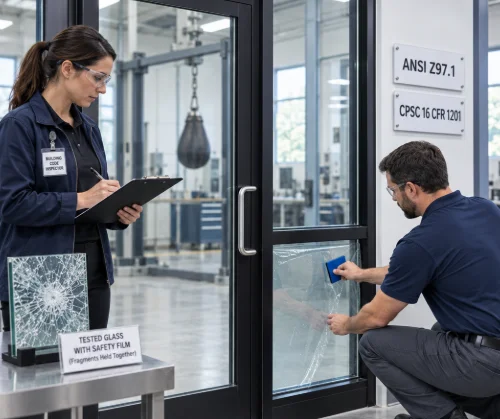
Glass may look safe until someone falls into it, walks into a door, or hits a glazed panel. When glass breaks into large, sharp pieces, the risk of serious cuts and other injuries increases. This is why safety glazing requirements exist for doors, shower enclosures, patio doors, and other locations where human impact may occur.
Two names appear often in U.S. glazing specifications: ANSI Z97.1 and CPSC 16 CFR Part 1201. They are closely related, but they are not the same thing. Window film can also fit into this system, but only when the correct film-and-glass configuration has the required test support.
For architects, facility managers, property owners, contractors, and specifiers, the important question is not simply, “Is this a safety film?” The better question is, “Has this glazing configuration been tested for the standard and classification required for this location?”
What Is ANSI Z97.1?
ANSI Z97.1 is a safety performance standard for glazing materials used in buildings. It sets test methods and minimum performance requirements intended to reduce cutting and piercing injuries when glazing is broken by human impact.
As of October 2026, ANSI Z97.1-2026 is the current edition. The standard covers safety performance and testing, but it does not decide every location where safety glazing must be used. That decision usually comes from an adopted building code, regulation, project specification, or other applicable requirement.
In simple terms, ANSI Z97.1 answers questions such as:
- How should safety glazing be impact tested?
- How should the material behave when it breaks?
- What performance class did the tested glazing achieve?
- What additional tests apply to certain glazing materials?
- How should compliant safety glazing be identified?
The standard applies to different types of architectural glazing, including tempered glass, laminated glazing, organic-coated glazing, plastic glazing, and other covered products.
What Is CPSC 16 CFR Part 1201?
CPSC 16 CFR Part 1201 is a U.S. federal consumer product safety standard for architectural glazing materials. Its purpose is to reduce serious injuries caused when people accidentally impact glazing.
The federal scope specifically covers glazing used in storm or combination doors, doors, bathtub doors and enclosures, shower doors and enclosures, and sliding glass patio doors.
Unlike ANSI Z97.1 by itself, CPSC 16 CFR Part 1201 is a federal regulation for products within its scope. Manufacturers and other responsible parties also have certification obligations under applicable CPSC requirements.
There is one important detail for current specifications.
ANSI Z97.1-2026 is now the latest ANSI edition, but the current text of 16 CFR 1201.4 still requires applicable products to be tested using the provisions of ANSI Z97.1-2015 incorporated into the federal rule. A newer ANSI edition does not automatically replace the edition written into a federal regulation.
For a real project, always check the adopted building code, local amendments, project specifications, and requirements of the authority having jurisdiction.
ANSI Class A vs. Class B and CPSC Category I vs. II
One of the easiest places to get confused is the different naming systems.
ANSI uses Class A and Class B. CPSC uses Category II and Category I. The CPSC aligned these classifications so that Category II corresponds to Class A, while Category I corresponds to Class B.
| Classification | Equivalent | Impact Level | General Meaning |
|---|---|---|---|
| CPSC Category I | ANSI Class B | 150 ft-lb | Lower impact classification |
| CPSC Category II | ANSI Class A | 400 ft-lb | Higher impact classification |
Under the CPSC definitions, Category I includes certain storm doors and doors where no single piece of glazing is larger than 9 square feet. Category II includes shower and bathtub enclosures, sliding patio doors, and certain doors containing glazing larger than 9 square feet.
These classifications should not be selected by guesswork. The location, exposed glazing area, adopted code, glass type, and project requirements all need to be considered.
Where Does Safety Window Film Fit?
Window film can be part of a safety glazing solution.
CPSC regulations define “organic-coated glass” as glass coated and bonded on one or both sides with an applied polymeric coating, sheeting, or film. This means a properly tested film-and-glass configuration can fall within the safety glazing framework.
However, putting any film on ordinary glass does not automatically turn that glass into code-compliant safety glazing.
A test report may identify details such as:
- Film manufacturer and product
- Film thickness
- Glass type
- Glass thickness
- Tested specimen size
- Impact classification
- Applicable standard
- Conditions under which the test was performed
For example, third-party ANSI Z97.1 and CPSC test reports for architectural film products identify both the film and the glass construction used during testing. This is why the tested glazing assembly matters more than a general statement that a film is “safety rated.”
Can Window Film Make Existing Annealed Glass Safer?
It can help retain broken glass when the correct safety film is bonded to a compatible glass surface. Certain tested film-and-glass constructions have achieved ANSI Z97.1 and CPSC classifications.
That does not mean every film will work on every glass type.
Annealed glass, tempered glass, laminated glass, insulated glass units, different glass thicknesses, and different film constructions may behave differently during impact. A specification should therefore be based on test documentation that reasonably matches the proposed glazing configuration.
For a retrofit project, check:
- Existing glass type
- Existing glass thickness
- Film model and thickness
- Required ANSI or CPSC classification
- Tested glass substrate
- Maximum tested size or size classification
- Required labeling or identification
- Local code acceptance
- Manufacturer technical documentation
If the required documentation does not match the proposed assembly, do not assume equivalent performance.
Our products
Six film families, one for every kind of glass
For commercial glass safety and security, start with Safety and Security. Every family has its own page with the full range.
- Clarity IR Max
- Nano Ceramic
- Climate IQ 50
- Skyline
- Harmony DR
- Soft Tone
- Eco Silver 20
- X-Clear 70
- X-Eco Silver 15
- X-Hybrid DR 15
- Safety 4 Clear
- Security 8 Clear
- Security 8 Silver
- Security 14 Clear
- X-Safety 7
- AG 6 Clear
- Frost
- White Out
- Black Out
- Poly Layers
- V6 Comfort BLK
- V10 Ceramic IR BLK
- V16 Ceramic IR MAX
- V6 Core
- V10 Reactive
- V16 Velocity
Safety Glazing Is Not the Same as Security Glazing
This distinction is extremely important.
ANSI Z97.1 and CPSC 16 CFR Part 1201 are mainly concerned with reducing injury from accidental human impact and hazardous breakage. Passing these tests does not automatically mean the glazing is rated for burglary, repeated forced entry, bullets, explosions, or severe storm debris.
Other performance goals can require different test standards. Industry guidance separates human-impact safety glazing tests from standards used for forced entry, ballistic resistance, blast performance, and other security threats.
A building may therefore need more than one performance requirement.
For example:
- Human impact risk → safety glazing requirement
- Smash-and-grab risk → forced-entry performance may be needed
- Blast exposure → blast-specific testing may be needed
- Severe windborne debris → storm-specific testing may be needed
Do not use a basic safety glazing classification as proof of performance against a completely different threat.
Safety Film vs. Tempered and Laminated Glass
There is no single glazing material that is automatically best for every project.
Tempered Glass
Tempered glass is specially treated so that, when highly tempered glass breaks, it normally breaks into many smaller particles instead of the large sharp pieces associated with ordinary annealed glass.
It is commonly used where safety glazing is required, subject to the applicable product rating and building code.
Laminated Glass
Laminated glass uses two or more pieces of glass bonded with an intermediate resilient plastic layer. The interlayer can help keep broken pieces together after fracture.
It is often selected when fragment retention is important in addition to impact safety.
Safety Window Film
A tested safety film can offer a retrofit route for suitable existing glazing. Because the film bonds to the existing glass, replacement of the entire lite may not always be the only option.
The important word is “tested.” The film, glass substrate, classification, and project conditions must be checked before making a compliance claim.
What Specifiers Should Request Before Approving Film
Do not approve a safety glazing film based only on a brochure headline.
Request technical documentation that clearly answers the following questions:
1. Which Standard Was Used?
The document should clearly identify ANSI Z97.1, CPSC 16 CFR Part 1201, or both when applicable.
2. What Classification Was Achieved?
Look for the required Class A, Class B, Category I, or Category II rating.
3. Which Glass Was Tested?
Check the glass type and nominal thickness used in the report.
A result on one substrate should not automatically be treated as proof for every possible glass construction.
4. Which Film Was Tested?
Confirm the exact product name and film construction rather than accepting a general product-family claim.
5. Was Testing Performed by a Qualified Laboratory?
Third-party testing can provide clearer evidence that a specific glazing construction has achieved a stated performance level.
6. Does the Proposed Application Match the Report?
Compare the project glass, film, location, size, and configuration with the test documentation.
7. Does the Local Code Accept the Solution?
Building codes and amendments can vary by jurisdiction. The final compliance decision may involve the building official or other authority having jurisdiction.
Do Not Confuse Safety Glazing Film With Solar or Automotive Film
Several types of film use similar words, but they solve different needs.
A solar protection film is generally selected to manage solar heat, glare, visible light, or UV exposure. A solar protection film for windows should not be described as safety glazing only because it is applied to glass. It needs the appropriate safety-glazing test evidence if a safety rating is being claimed.
The search what is paint protection film refers to a completely different product category. Automotive PPF is designed to protect painted vehicle surfaces from physical damage and is not an architectural safety glazing material.
Likewise, clear paint protection film relates to vehicle paint protection rather than ANSI Z97.1 building-glass compliance.
The phrase car window film protection also belongs mainly to the automotive market. Vehicle glazing and automotive window film should not be mixed with U.S. architectural glazing requirements for buildings.
Keeping these subjects separate makes the content clearer for users and helps avoid conflicting search intent.
Keep reading
More commercial safety and security guides
Common Safety Glazing Specification Mistakes
A small wording mistake in a glazing specification can create a much larger issue during product approval or inspection.
Common mistakes include:
- Assuming every thick window film is safety rated
- Treating ANSI Z97.1 and CPSC 16 CFR 1201 as identical rules
- Ignoring the required impact classification
- Using a test report from a different glass substrate
- Assuming safety glazing means forced-entry protection
- Selecting film before identifying the required code
- Ignoring local amendments or project-specific requirements
- Using marketing claims instead of test documentation
- Assuming the newest ANSI edition is automatically the edition incorporated into federal regulation
A stronger approach starts with the required performance and works backward to the product.
A Simple Safety Glazing Selection Process
Step 1: Identify the Glazing Location
Confirm whether the glass is in a door, shower enclosure, patio door, glazed wall, sidelight, or another location controlled by the applicable building code.
Step 2: Check the Adopted Code
Find the code edition and local amendments that apply to the project.
Step 3: Identify the Required Rating
Determine whether the glazing must meet Class A, Class B, Category I, Category II, or another requirement.
Step 4: Confirm the Existing Glass
For retrofit work, identify the glass type, thickness, dimensions, and condition.
Step 5: Match the Tested Configuration
Select only a safety film solution with documentation that supports the proposed glass and required performance.
Step 6: Review the Full Submittal
Check test reports, technical data, product identification, and any required labeling information before final approval.
Step 7: Confirm With the Project Authority
Where acceptance is unclear, confirm the proposed glazing system with the architect, code consultant, building official, or other authority responsible for the project.
Why Test Documentation Matters More Than Film Thickness
Film thickness alone does not prove code compliance.
Two films with similar thicknesses can use different polyester constructions, adhesives, laminates, coatings, and manufacturing methods. They may also be tested on different types or thicknesses of glass.
The correct specification is therefore not:
- “Use a thick safety film.”
A better specification identifies the required standard, classification, product, supported glass configuration, and required supporting documentation.
This approach gives architects, facility teams, and property owners a much clearer basis for product approval.
Choose Safety Glazing by Evidence, Not Assumptions
Safety glazing compliance is not simply a choice between ordinary glass and safety film. The correct solution starts with the location, applicable code, required impact class, glass construction, and supporting test documentation.
ANSI Z97.1 provides an established safety performance framework, while CPSC 16 CFR Part 1201 creates federal requirements for specific architectural products. Tested window film can fit within that framework, but only when the proposed glazing configuration is supported by the correct evidence.
For retrofit projects, ask for the test report before accepting a safety claim. Match the report to the glass, film, classification, and project requirement. That simple process can prevent specification gaps, rejected submittals, and incorrect assumptions about glazing performance.
FAQ
Frequently asked questions
Quick answers about safety glazing codes, ANSI Z97.1 and CPSC 16 CFR 1201.
Still have a question? Ask usIs ANSI Z97.1 a law?
ANSI Z97.1 is a voluntary consensus safety standard. It can become enforceable when referenced by a building code, regulation, contract, or project specification. CPSC 16 CFR Part 1201, by comparison, is a federal regulation for architectural glazing products within its scope.
What is the latest version of ANSI Z97.1?
ANSI Z97.1-2026 is the current edition as of October 2026. It replaced ANSI Z97.1-2015 (R2020).
Does CPSC 16 CFR 1201 already use ANSI Z97.1-2026?
No. The current wording of 16 CFR 1201.4 still incorporates the applicable test provisions of ANSI Z97.1-2015. Always check for future regulatory updates before preparing a new specification.
Is ANSI Class A the same as CPSC Category II?
For impact classification, CPSC Category II corresponds to ANSI Class A and uses the higher 400 ft-lb impact level. CPSC Category I corresponds to ANSI Class B at 150 ft-lb.
Can safety film make regular glass code compliant?
A properly tested film-and-glass construction may satisfy an applicable safety glazing requirement, but the result cannot be assumed for every film or every glass type. Verify the test report, substrate, classification, adopted code, and project acceptance.
Is safety window film unbreakable?
No. Safety film should not be described as making glass unbreakable. Its role can include helping retain glass after breakage when used in a tested glazing construction.
Does solar window film automatically meet safety glazing requirements?
No. Solar-control performance and human-impact safety performance are different requirements. A product needs appropriate safety glazing test documentation before it should be specified for that purpose.
Does passing ANSI Z97.1 mean the glass is burglar resistant?
No. ANSI Z97.1 addresses safety glazing performance related to human impact. Forced-entry, ballistic, blast, and other security objectives use separate test methods and performance criteria.
Contact us
Worried about exposed glass? Tell us about the building.
Send us which glass worries you most, the type of doors and frames and what you want to protect against, and we will point you to the right next step.
Contact us-
Visit
12551 Steepleway Blvd SWB B101
Houston, TX 77065 - Hours Mon to Fri 9am to 5pm